Managing Museum Retail Without Creating More Work for Your Team
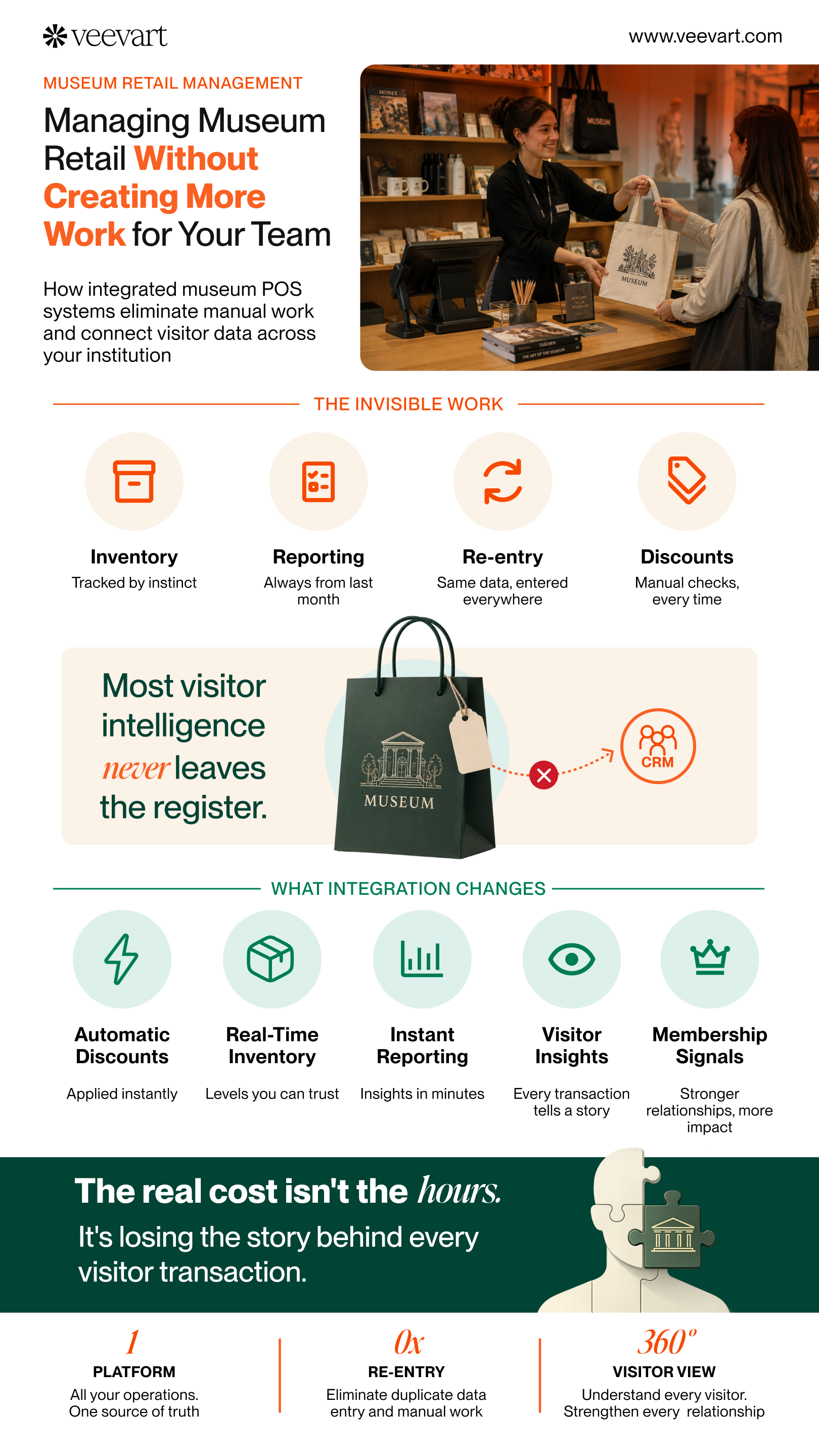
Five o'clock. The last visitor has left. The shop manager is at the register doing what she does every closing shift, drawer count, a scan of the shelves for anything that is running low, and a quick check that the POS total looks right. The gaps go in a notebook kept under the counter. Not in the system. In a notebook, because that's faster and the system wouldn't know what to do with it anyway.
Those numbers get typed into a spreadsheet tomorrow. At the end of the month, someone cross-references that spreadsheet against accounting. Then works out why three line items don't match and eventually produces a sales summary. By the time it lands in anyone's inbox, it describes a shop that existed four weeks ago. Depressing.
Nobody designed this process. It accumulated the same way most museum operations accumulate with one workaround at a time. Each solving an immediate problem without anyone asking what it was costing downstream.
What it costs downstream: hours of manual data entry every week, inventory decisions made on month-old information, and a shop full of visitors whose purchasing behavior is invisible to everyone except the person who rang them up.
The Shop Knows Things Nobody Else Does
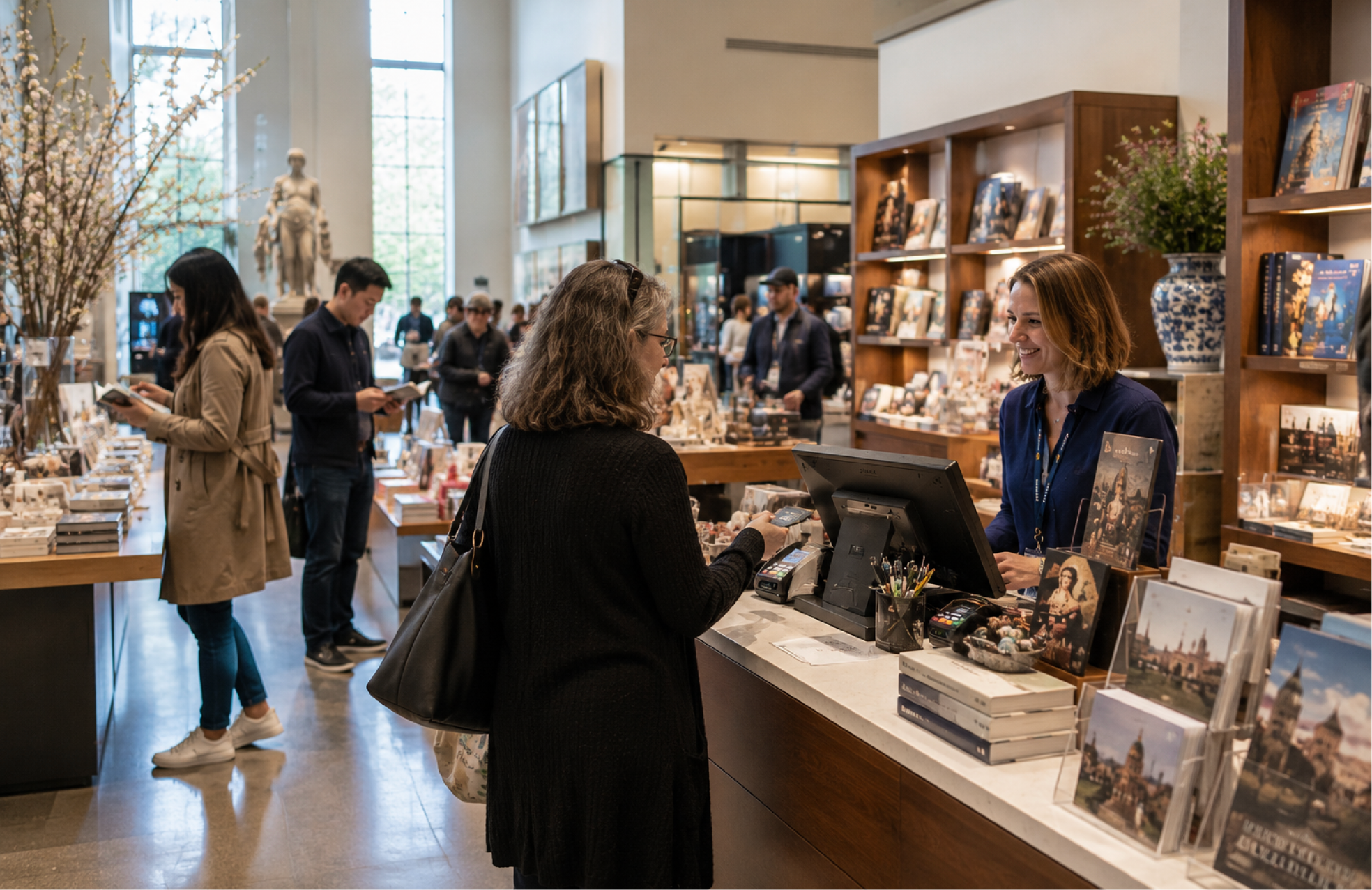
Every transaction in your gift shop is a data point about visitor engagement. The family that spends $60 on items from the current exhibition is telling you the exhibition landed. The member who picks up a catalogue is telling you they want to go deeper and learn more. The first-time visitor who buys a $12 magnet and nothing else is telling you something different from the one who spends twenty minutes and leaves with three items.
None of those buyer signals reaches the rest of your institution. Not the development team thinking about donor cultivation, Not the membership team thinking about conversion. And certainly not the programming team thinking about what to build next. It evaporates at the register because the POS is a standalone system that captures transactions in a silo and nothing else.
This matters beyond the missed intelligence. Consider what it means for a member who visits regularly, donates annually, and shops in the store on every visit. In your CRM, she's a strong supporter. In your POS, she's a transaction with no name attached. Those two pictures of the same person have never been introduced to each other. Which means nobody on your team has ever seen the full picture of her relationship with the institution, and nobody has used it to deepen that relationship before her next renewal comes up.
Where the Work Actually Goes
Museum retail is labor-intensive in ways that do not show up on a job description. The visible work is running the shop, staffing the floor, processing transactions, and helping visitors. The invisible work is everything the disconnected systems create on top of that.
Inventory management by instinct. When your POS doesn't connect to a central inventory system, stock levels live in a spreadsheet that's only as accurate as the last time someone updated it. Reordering decisions get made by walking the floor and eyeballing what's low. Which means you run out of your bestselling exhibition catalogue three weeks before the show closes, and you're sitting on forty units of something that hasn't moved since last spring.
Sales reporting as a project. A shop manager who needs to know which product categories are performing needs to export from the POS, format it, and build the analysis manually. That takes time she doesn't have, so it happens quarterly instead of weekly, which means she's making buying decisions on data that's already three months stale.
Re-entry as a full-time job. When a transaction happens in the shop, it exists only in the POS. For it to reach accounting, someone enters it again. For it to reach the membership system, when a member uses their discount, someone has to manually note it or it does not get noted at all. Every system boundary in your retail operation is a place where a human is doing work that a connected system would do automatically.
The member discount problem. Most museums offer members a discount in the shop. Applying that discount requires staff to verify membership at the register, either by checking a card, looking someone up in a separate system, or taking their word for it. When the POS and the membership database are disconnected, this is a friction point every single time. The staff feel it. The members feel it. And the discount that is supposed to reinforce the value of membership instead produces a small moment of awkwardness several times a day.
What Integration Actually Changes

When the gift shop POS connects to the same system that holds your membership, ticketing, and donor data, the invisible work starts to disappear.
Member discounts apply automatically at the register; the system recognizes the member, applies the benefit, and logs the transaction against their record without anyone having to do anything extra. The membership team can now see that a particular member visits four times a year and spends an average of $35 in the shop on each visit. That is information worth having before a renewal conversation.
Inventory levels update in real time as transactions happen, so reorder decisions are based on what is actually in stock today and not what was in stock when someone last updated the spreadsheet. When an item connected to a current exhibition starts moving faster than expected, the system surfaces it. Not a staff member walking the floor on a hunch.
Sales reporting stops being a project. The shop manager who wants to know which categories are up this month runs a report. It takes four minutes. It reflects the morning's transactions. They don't need to export anything or reconcile anything or wait until next quarter.
And the transaction data that used to evaporate at the register now flows into the same record as everything else the institution knows about that visitor. The development director can see that a prospect who attended a major donor event last month also spent $120 in the shop that evening. The membership team can see which non-members are shopping repeatedly, which is one of the cleaner signals that someone is ready to be asked about joining.
The Real Cost of Keeping Things Separate
The case for an integrated POS usually gets made on efficiency grounds such as less manual work, faster reporting, and cleaner inventory. Those are real benefits and they are worth having. But the deeper cost of a disconnected shop is not the hours. It is that your highest-frequency visitor touchpoint is generating zero relationship intelligence.
A visitor might attend two or three times a year. They might donate once. They might interact with your email list monthly. But if they shop, they are in the gift shop on nearly every visit, and that interaction is currently invisible to the people who most need to understand visitor engagement.
The gift shop isn't just a revenue line. For a lot of visitors, it's the last thing they do before they leave. Which makes it the last impression the institution makes. Managing it well matters. Managing it in a way that connects it to the rest of what you know about your visitors matters more.
Veevart's integrated POS connects your gift shop directly to your membership, ticketing, and donor records, so your retail operation runs leaner and every transaction becomes part of a fuller picture of visitor engagement. [See how it works for museums like yours.]