Online vs On-Site Ticketing: Why Museums Need Both in One System
The family bought tickets online three days ago. Timed entry, 11am, two adults and two children, member discount applied. They drove forty minutes, found parking, and walked up to the entrance at 10:58.
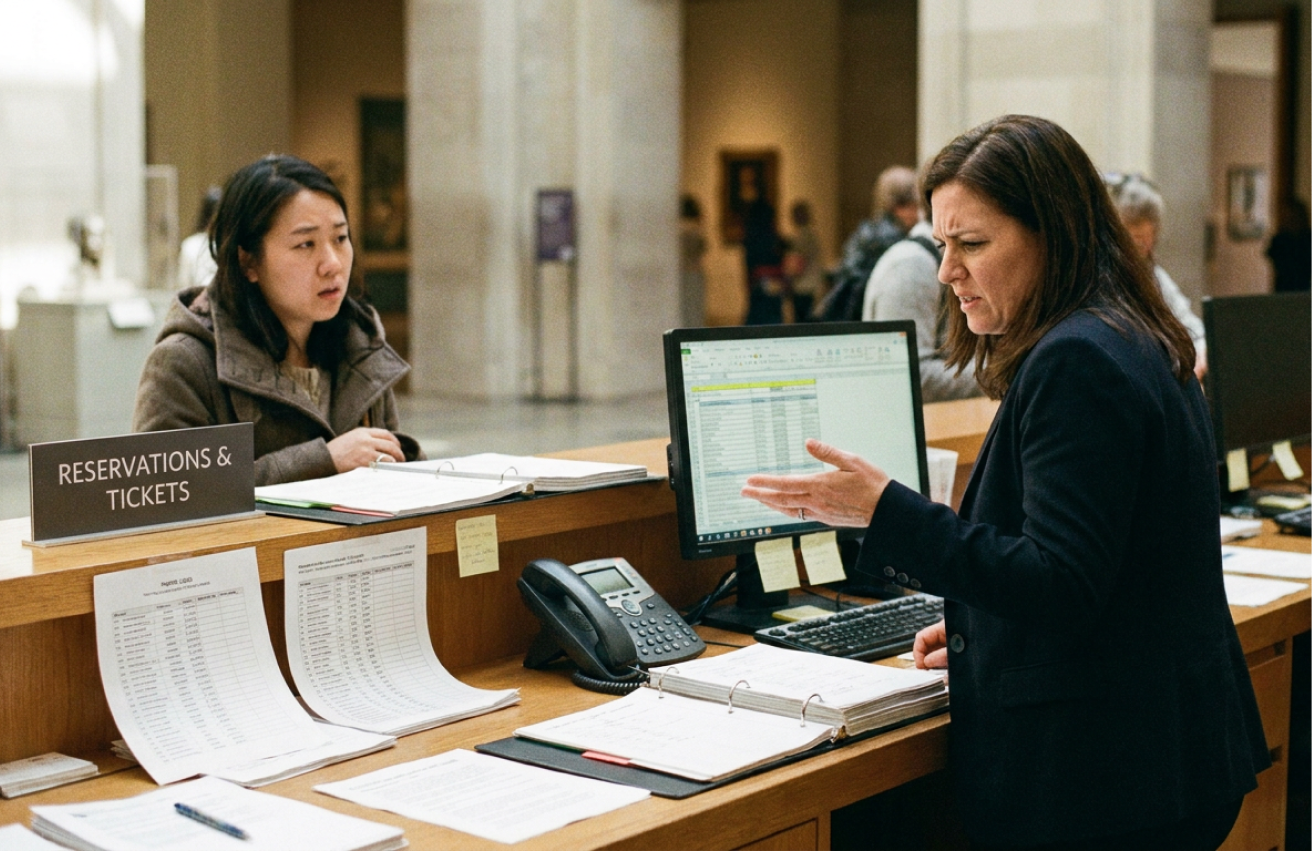
The front desk can't find the reservation.
Not because it does not exist. It does, in the online ticketing platform. But the on-site system does not pull from the same database, and the morning sync has not run yet. The staff member at the desk is now doing what staff members in this situation always do: asking the family to show their confirmation email on a phone, manually verifying the member discount, waving them through on goodwill while a line forms behind them.
The ticket was real. The membership was valid. The discount was earned. None of that was in question.
What was in question, for four minutes on a Saturday morning, was whether this institution had its act together. That impression formed at the front door. Two kids in tow. A forty-minute drive behind them. A parking receipt already paid. It does not disappear the moment they walk inside.
Two Systems, One Visitor, Zero Shared Truth
Most museums did not intentionally design their current ticketing systems. Like much of their technology, those systems evolved incrementally over time. Meaning they were solving one problem at a time without a clear view of how each decision connected.
The website needed to sell tickets. The existing point-of-sale system could not support it. So online ticketing became its own system. So a third-party platform was added. Maybe Eventbrite? A ticketing SaaS tool implemented years ago by a previous director. It stayed in place long after the original decision was made. It works for online sales. It just does not know anything about what’s happening at the front desk.
The on-site POS came from a different direction. It was built around cash handling, walk-up admissions, membership verification, and/or gift shop sales. It knows the physical operation well. But it has no real-time view of what has been sold online.
Between them sits the problem: two systems maintaining two separate pictures of the same inventory, the same members, and the same day’s capacity. When those pictures do not match, and they regularly do not, the gap shows up at the door.
This is more common than most people assume. According to the Museum Innovation Barometer, roughly 45% of museums operate without a fully integrated system. Larger national institutions are increasingly moving to unified software, but a significant share still runs separate, fragmented tools for online presales and on-site box office management, which means the gap described above is not an edge case. It is close to half the field.
What the Gap Actually Costs
The family at the entrance is the visible version of the problem. There are less visible versions that cost more.
Overselling timed entry slots. When online sales and walk-up admissions aren't drawing from the same inventory in real time, you can sell more timed slots than the space can hold. The online platform thinks capacity is available because it can't see the walk-ups. The front desk is selling walk-up tickets because it cannot see the online sales that have already filled the slot. The problem surfaces when more people show up for the 2 pm entry than the gallery can accommodate, and the person who has to explain that is the staff member at the door.
Member discounts that don't transfer. A member who buys tickets online expects the discount to apply. When the online platform and the membership database are not connected, that verification happens by honor system or by asking the member to prove membership at the door. This friction point can make the membership feel less valuable at exactly the moment it should feel most useful. When the on-site system doesn't recognize an online purchase as member-verified, the conversation at the desk starts from suspicion rather than welcome.
Capacity reporting that's always wrong. When the day ends and someone needs to know how many people came in, the answer requires adding two numbers from two systems and hoping neither had an error or a lag. For planning purposes, for grant reporting, for any analysis of attendance patterns, this means the data is always an approximation. Not wildly off, usually. But not clean, and not trustworthy enough to build decisions on without a caveat.
Staff time spent bridging the gap. Every morning somewhere in the museum, someone is reconciling yesterday's online sales against the on-site records. They look for discrepancies while updating a spreadsheet, and starting the day with the previous day's numbers instead of a real-time picture. Depending on the size of the institution, this reconciliation runs anywhere from 30 minutes to 3 hours every day. On a modern integrated platform, that same reconciliation is automated and effectively instantaneous. On legacy systems built around manual counts, it is a standing daily tax on someone's time. That time exists entirely because two systems cannot talk to each other.
What a Unified System Actually Means at the Door
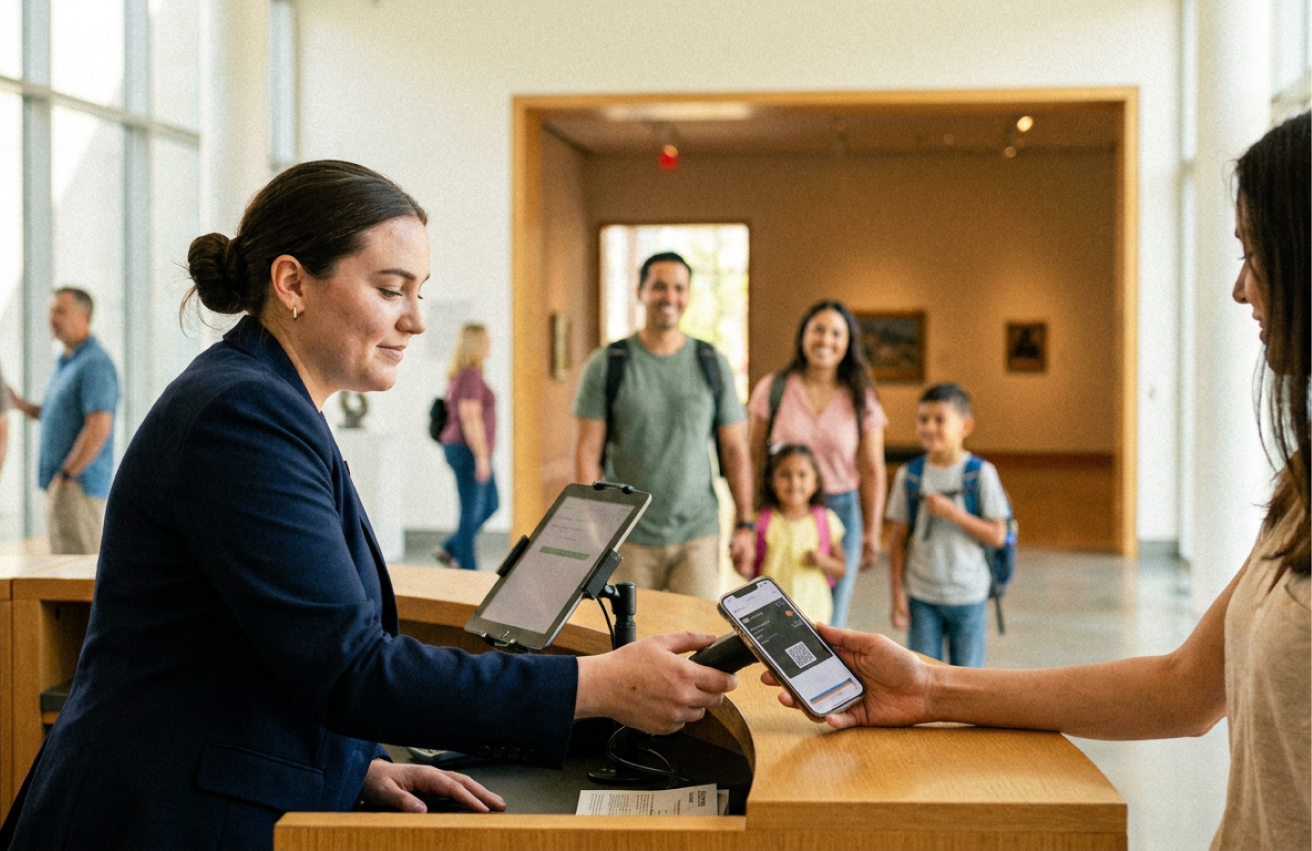
When online and on-site ticketing draw from the same inventory in real time, the family at the entrance has a different more positive experience.
The front desk sees the reservation. The member discount is already verified. The timed entry slot was drawn from the same pool whether it was sold online or at the desk. Meaning capacity is accurate. Check-in is a scan or a thirty-second lookup, not four minutes with a line forming behind them, and no goodwill required to smooth it over.
That's the visitor-facing version. The operational version is just as significant.
Timed entry slots cannot be oversold because every sale that’s online or walk-up, is pulled from one inventory. When the 2 pm slot fills, it fills on both channels simultaneously. No one shows up to a gallery that cannot hold them, because the systems had different information about how many tickets were left.
Membership verification happens at the point of purchase, not at the door. A member buying online is recognized as a member by the same system that will check them in on-site. The discount applies automatically. The verification doesn't need to happen twice.
Attendance data is complete by the end of the day. No reconciliation required. One system records everything. Online presales. Walk-up admissions. Member entries. Group bookings.The report reflects what actually happened, not what two systems thought happened when someone added them together.
The staff member at the front desk is doing their actual job. Welcoming visitors. Answering questions. Making the entrance feel like the beginning of an experience worth having. Not troubleshooting a disconnect between two systems that should have been one.
The Part That Doesn't Show Up in the Demo
Every ticketing platform demos well. The online purchase flow is clean. The on-site POS is fast. What does not show up in the demo is what happens when both are running simultaneously on a busy Saturday, whether they are drawing from the same inventory, whether a membership verified in one is recognized by the other, whether the end-of-day numbers require manual reconciliation or just exist.
Those are the questions worth asking before a system goes live, because they're the questions that determine whether the technology serves the visitor experience or occasionally undermines it. A platform may handle online sales well. It may handle on-site sales just as well. But if those systems operate separately, only half the problem has been solved. The rest gets pushed onto staff through manual workarounds.
The visitor standing at the door doesn't know which system sold them their ticket. They just know whether walking in felt smooth or didn't. That impression is formed in the first ninety seconds of their visit, and it travels with them through everything that comes after.
Veevart's ticketing runs online and on-site from a single system, same inventory, same member verification, same real-time data at every touchpoint.