Should Museums Be Free? Rethinking the Admission Debate
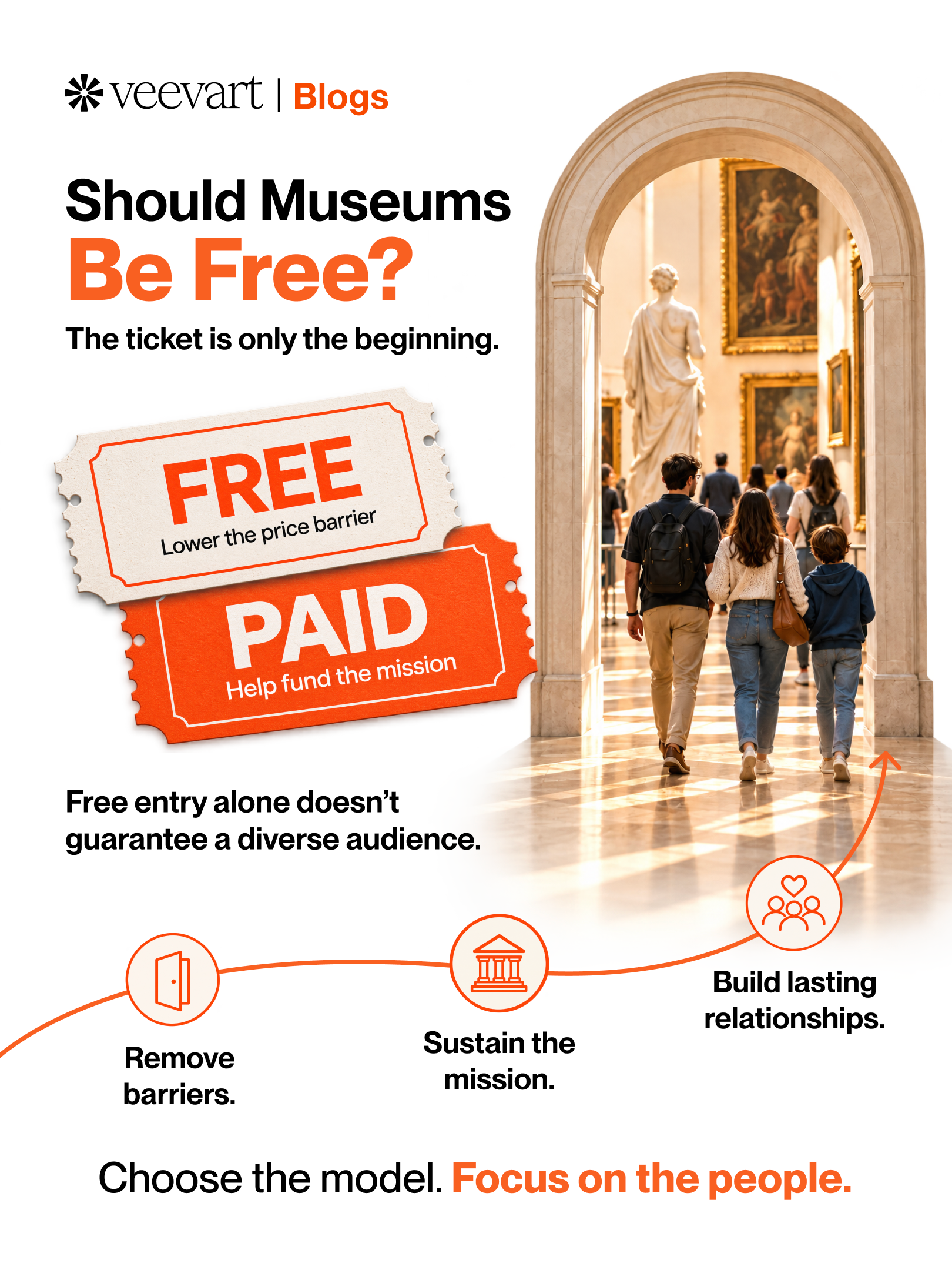
Few questions divide the museum world as cleanly as this one.
On one side: museums exist to serve the public, and a ticket price is a barrier between people and their own cultural heritage. Admission should be free, full stop. On the other: a museum that can't fund itself can't serve anyone, and "free" admission just means someone else is paying. Charging is how an institution survives to keep its doors open at all.
Both positions are held by serious, mission-driven people. Both are partly right. And the debate between them usually generates more heat than light, because it's framed as a binary when the reality is a spectrum, and because the intuitive answer turns out to be complicated by the evidence.
This piece is an attempt to think through the admission question honestly: what each side gets right, what the data actually shows, and why the most useful question isn't "free or paid" at all.
The Case for Free
The argument for free admission is rooted in mission, and it's a strong one.
Museums hold collections in the public trust. Most of them exist to educate, preserve, and make culture accessible to everyone. Not only those who can afford a ticket. From that premise, charging admission looks like a contradiction: an institution built to democratize access putting a price on the door.
Free admission removes the most visible barrier to entry. It makes the spontaneous visit possible, the one where someone wanders in on a free afternoon with no prior plan. It signals that the museum belongs to the community rather than to its paying customers. And for publicly funded institutions, free entry is often the explicit expression of why public money supports them in the first place. Several of the world's great museums, from the Smithsonian to the UK's national collections, treat free admission as central to their identity.
This is the case that feels morally obvious. And it's exactly the one the evidence complicates.
The Case for Charging
The counterargument isn't about greed. It's about survival, and it's grounded in a hard fact: free admission is never actually free. Someone funds it, whether that's an endowment, a government, or a donor base. An institution without that funding base can't choose to be free. It can only choose to be unsustainable.
The most instructive recent example is the Metropolitan Museum of Art. For nearly fifty years, the Met ran on a pay-what-you-wish model, one of the most egalitarian admission policies of any major museum in the world. It was by its own account, the only museum among its peers without either a mandatory fee or majority government funding. Then in 2018, it partially abandoned that model. Starting that March, the museum began charging a mandatory $25 fee for most adult visitors from outside New York State, while keeping pay-what-you-wish for state residents.
Why would the most famously accessible museum in America start charging? Because the model stopped working. The share of visitors paying the full suggested admission had fallen sharply over the previous decade-plus. The museum was running a multimillion-dollar deficit against an operating budget north of $300 million. The institution's president at the time put it bluntly that the existing policy had failed. The change was projected to raise an additional $6 million to $11 million a year.
The Met's story is the whole argument for charging in miniature. Even an institution with a multibillion-dollar endowment and deep public identification with free access found that voluntary payment couldn't sustain the operation alone. For the vast majority of museums that have none of the Met's advantages, the math is far less forgiving. Admission revenue isn't a betrayal of the mission. For many institutions, it's what funds the mission.
What the Evidence Actually Shows
Here's where the debate gets genuinely interesting. The strongest argument for free admission is that it broadens access and diversifies audiences. However, research doesn't strongly support this claim.
A major study of UK museums, "Taking Charge," commissioned by the Association of Independent Museums and funded by Arts Council England and the Welsh Government, examined exactly this question. Its central finding was counterintuitive: there is no direct link between whether a museum charges for admission and the diversity of its audience. Free and charging museums had strikingly similar visitor profiles. Higher social grades accounted for roughly 60 percent of visitors at both free and charging sites, while lower social grades remained under-represented at both.
In other words, making a museum free does not automatically make its audience more diverse. The people who take advantage of free admission are disproportionately the people who would have visited anyway. It turns out that the financial barrier is often not the barrier that keeps under-represented groups away. Factors like education, confidence, transportation, and whether someone feels a museum is "for them" matter more than the price of a ticket.
This finding deserves honest handling with caveats. The research excluded the large national museums, focused on social class rather than race, and drew partly on staff perceptions. And it found that free admission does genuinely benefit some groups, particularly local visitors and families. Most free museums believed their policy had a positive effect on their visitor mix, even where the demographic data didn't confirm it. The point isn't that free admission does nothing. It's that free admission alone does not deliver the access outcomes its advocates assume it does.
That complicates both sides. It weakens the strongest moral argument for free entry, and it undercuts the idea that charging is inherently exclusionary.
Why the Binary Is the Wrong Frame
If free admission doesn't automatically broaden access, and charging doesn't automatically exclude, then "should museums be free?" is the wrong question. It treats admission policy as a single switch, when in practice it's a set of choices along a spectrum.
Most museums already operate somewhere in the middle:
Free general admission with paid special exhibitions
Pay-what-you-wish or suggested donation
Free days, free evenings, or free hours each week
Free for members, children, students, or local residents
Tiered pricing that charges those who can pay and waives fees for those who can't
Each of these is a different answer to a more precise set of questions than the binary allows. Who is this institution trying to reach, and what actually keeps those people away? What funding does it have, and what does admission revenue need to cover? Is the goal access, sustainability, or both, and where do they genuinely conflict?
A museum that asks these questions will arrive at an admission strategy that fits its mission and its means. A museum that just asks "free or paid" will arrive at an ideology.
The Question Underneath the Question
Here's what the admission debate tends to obscure. Whatever a museum charges, the harder and more important work is the same: understanding who actually comes, and building a real relationship with them.
A free museum still needs to know whether its visitors return, whether they become members and supporters, and how its access goals are actually being met or just assumed. A charging museum needs to make the ticket worth it. It needs to convert first-time visitors into lasting relationships, and understand who its price is reaching and who it isn't. Neither model does that work on its own. The admission policy sets the terms at the front door. It says nothing about what happens to the relationship after someone walks through it.
This is the part of the debate that gets lost in the argument over price. An institution can be free and still fail to build any lasting connection with the people it serves. It can charge and still cultivate a deeply loyal community. The real question goes beyond admission fees. Does the museum understand its audience well enough to turn a visit into a lasting relationship, regardless of the cost of admission?
So, Should Museums Be Free?
The honest answer is that it depends, and that the question matters less than it seems.
Free admission is a legitimate and often powerful choice for institutions that can fund it and that pair it with genuine, intentional work to reach the audience's price alone won't reach. Charging is an equally legitimate choice for institutions that need the revenue to survive and that use it to invest in the experience and the relationships that keep people coming back. Neither is a moral victory on its own. Both can serve the mission, and both can fail it.
Museums that get this right move beyond debating admission models and start asking better questions. Who are we reaching? What do we know about our visitors? And how do we turn those visitors, regardless of how they entered, into a lasting community? That's the work the admission debate distracts from. And it's the work that actually determines whether a museum thrives.
Veevart helps museums understand and build relationships with their visitors, whatever their admission model, by connecting ticketing, membership, and engagement data in one place, so an institution can see not just who came, but who stayed. See how it works.