The Hidden Complexity of Museum Financial Reconciliation
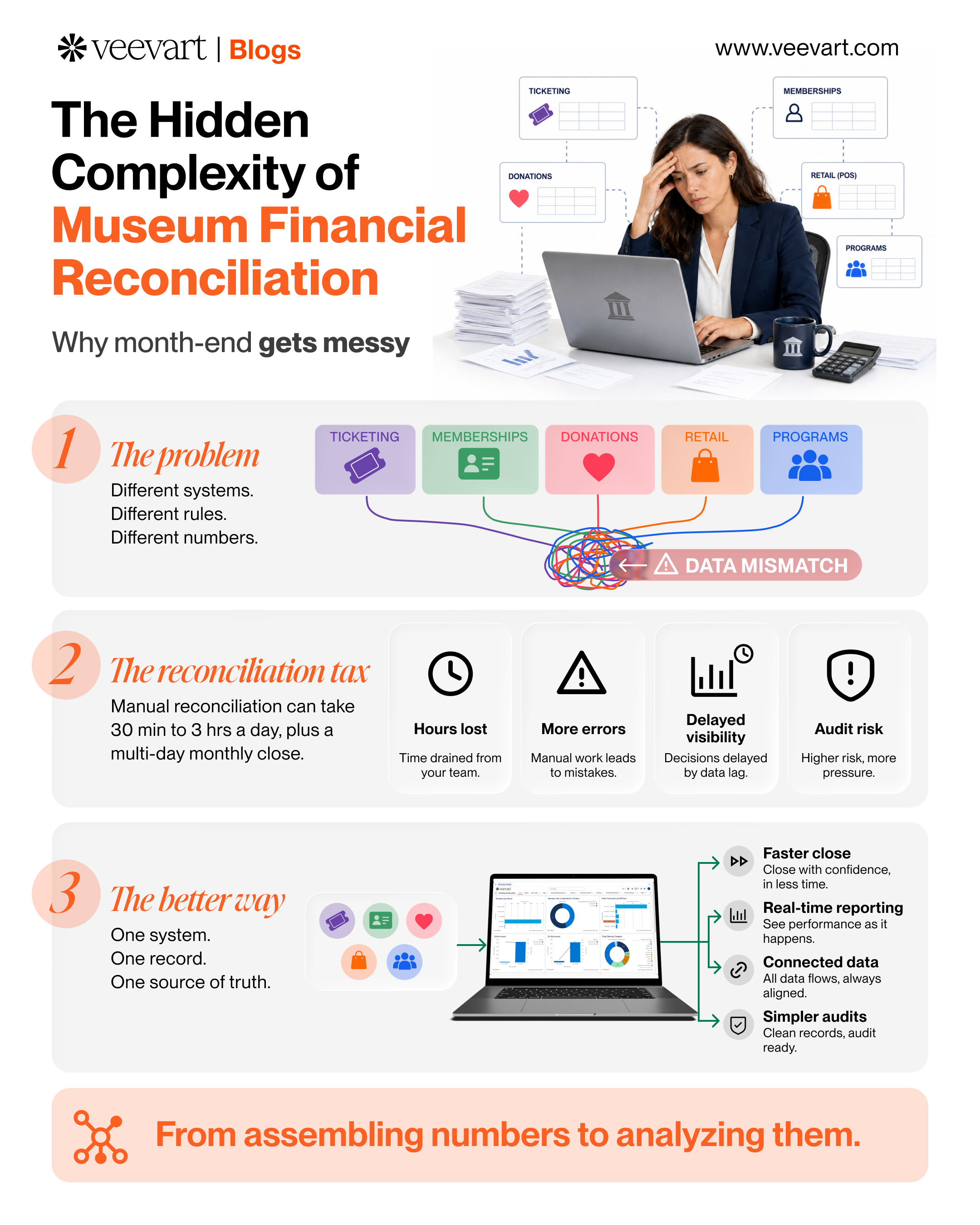
It's the fifth business day of the month. The finance manager is closing the books for the period that just ended.
Ticketing revenue is in one report. Membership dues are in another. Donations are in the donor database. Shop sales are in the POS. Program registrations are in a spreadsheet someone in the education department maintains. None of these numbers were recorded the same way, and none of them quite agree.
So the work begins. Export each one. Line them up. Find the membership payment that shows as revenue in one system and a pledge in another. Track down the $340 discrepancy between what the POS says the shop took in and what actually hit the bank. Figure out why the donation total includes a gift that was refunded last week.
By the time the books close, three days have passed. The numbers reconcile, more or less. And the finance manager signs off with the quiet awareness that "more or less" is doing a lot of work in that sentence.
This is museum financial reconciliation as most institutions actually experience it. Not a clean monthly close, but a recurring project of forcing several systems that count money differently to agree with each other.
Why Museum Finances Are Harder to Reconcile Than They Look

A museum's revenue doesn't arrive through one door. It arrives through several, each with its own logic.
Admissions come in as timed tickets, walk-ups, and group sales
Memberships are dues, often with a tax-deductible portion split from the benefit value
Donations range from one-time gifts to pledges to recurring giving
Retail is straightforward sales, but with member discounts and inventory costs attached
Programs and rentals carry deposits, balances, refunds, and cancellations
Each of these revenue streams are typically recorded in a different system. And each system was designed to do its own job well, not to hand clean, compatible financial data to the others.
That's the root of the problem. The ticketing platform counts a transaction one way. The donor database counts a related payment another way. When a member buys a ticket online, makes a donation, and picks up something in the shop on the same visit, that single visitor generates three records in three systems, and at month-end, someone has to recognize that those three records belong together and account for them correctly.
The work isn't hard because museum finance staff lack skill. It's hard because the systems were never built to agree.
The Reconciliation Tax
Every museum running separate systems pays what amounts to a recurring tax: the staff hours spent making those systems reconcile.
The size of the tax depends on the institution. Industry data suggests museums spend anywhere from 30 minutes to 3 hours a day on transaction reconciliation alone, depending on scale and how fragmented the technology is. That's before the monthly close, which compounds the daily work into a multi-day project.
But the cost isn't only time. It shows up in three other places.
Errors that compound. Every manual step is a chance for a number to be mistyped, a record to be missed, or a refund to be double-counted. Small errors in a monthly close become larger errors in a quarterly report and real problems in an annual audit.
Delayed visibility. When the close takes a week, leadership is always looking at last month's financial picture. Decisions about staffing, programming, and spending get made on data that's already weeks old.
Audit and grant risk. Museums report to boards, auditors, and grant funders. When financial data is assembled by hand from multiple systems, every report carries the risk that the numbers will not hold up under scrutiny, and the staff time spent preparing for an audit balloons accordingly.
What Integrated Reconciliation Actually Looks Like

When ticketing, membership, donations, retail, and programs all run through one system, reconciliation stops being a translation project.
Every transaction is recorded once, in one place, with consistent logic. The member who buys a ticket, makes a donation, and shops on the same visit generates one connected record, not three disconnected ones. The system already knows those transactions belong to the same person and categorizes each correctly: earned revenue here, contributed revenue there, with the tax-deductible split handled automatically.
The practical differences are significant:
The monthly close shrinks from a multi-day project to a review of numbers that already reconcile, because they were never separate to begin with
Daily reconciliation largely disappears, because the transactions and the financial records are the same data, not two sets that have to be matched
Reporting reflects reality in real time, so leadership sees an accurate financial picture today, not a reconstructed one next week
Audit preparation gets simpler, because there's a single, consistent source of truth with a clear record of every transaction
The finance manager's job shifts from assembling the numbers to actually analyzing them. That's the difference between a finance function and a translation function.
The Question Worth Asking at Month-End
If closing your books each month requires exporting from several systems and reconciling them by hand, the difficulty isn't a reflection of your finance team. It's a reflection of an architecture that asks them to make incompatible systems agree.
The useful question isn't how to reconcile faster. It's why reconciliation requires this much manual work at all.
A museum's money tells the story of how the institution is doing: which programs earn, which memberships convert, and where the revenue actually comes from. That story is far easier to read, and far more trustworthy, when it's recorded in one place instead of reconstructed from five.
Veevart unifies ticketing, membership, donations, retail, and programs in a single platform, so your financial data reconciles itself instead of demanding a multi-day close.