The Hidden Cost of Manual Processes in Museum Operations

The Work No One Sees
Most museums don’t struggle because of one dramatic failure. They struggle because of small, routine tasks that quietly compound over time.
A spreadsheet updated after a busy weekend.
A donor list exported “just to double-check.”
A manual reconciliation between ticketing and accounting before a board report.
Individually, none of these actions feel significant. In fact, they often feel responsible. But when manual museum workflows become embedded in daily operations, they begin shaping the organization in ways that aren’t immediately visible.
“This is how we’ve always done it” rarely sounds expensive. Over time, it becomes exactly that.
Manual processes affect far more than convenience. They influence museum operations efficiency at every level; how staff spend their time, how risk accumulates, how accurate reporting remains, and how confidently leadership can make decisions.
The cost doesn’t announce itself. It accumulates.
The Time Drain: Small Tasks, Massive Cumulative Impact
The first impact is time.
No single manual task seems excessive. Exporting a donor list takes a few minutes. Cross-checking ticket sales against the POS system might take half an hour. Updating membership records in a spreadsheet “for safety” feels prudent.
But when data lives across disconnected systems; ticketing, CRM, POS, accounting, email marketing then those small tasks repeat daily. Staff move between platforms, re-enter information, and reconcile records that should already align.
Over the course of a week, that repetition compounds.
If three staff members spend just five hours a week reconciling and manually updating information, that equals sixty hours per month. Nearly a full-time week redirected away from visitor engagement, fundraising strategy, programming development, or financial planning.
Lost time doesn’t just reduce productivity. It reduces museum operations efficiency in the areas that actually drive growth.
And because the tasks feel routine, the loss often goes unmeasured.
The Risk Layer: Errors That Compound Quietly
As manual effort increases, so does exposure to error.
Manual workflows rarely produce catastrophic mistakes. Instead, they introduce subtle inconsistencies; duplicate records, mismatched totals, slightly different membership counts across departments.
Each discrepancy can usually be corrected. But every export, copy-paste, and reconciliation creates another opportunity for drift.
Over time, small inconsistencies accumulate into larger questions:
Why doesn’t this report match finance’s numbers?
Why is this donor marked active in one system but lapsed in another?
Which version of the attendance report is correct?
The data itself may be technically correct. The problem is traceability. When numbers can’t be easily verified back to their source, confidence erodes even before anything goes wrong.
That erosion increases operational risk quietly. Audit preparation becomes more stressful. Compliance documentation requires extra manual effort. Board reporting feels defensive instead of straightforward.
The issue isn’t dramatic failure. It’s the slow accumulation of doubt.
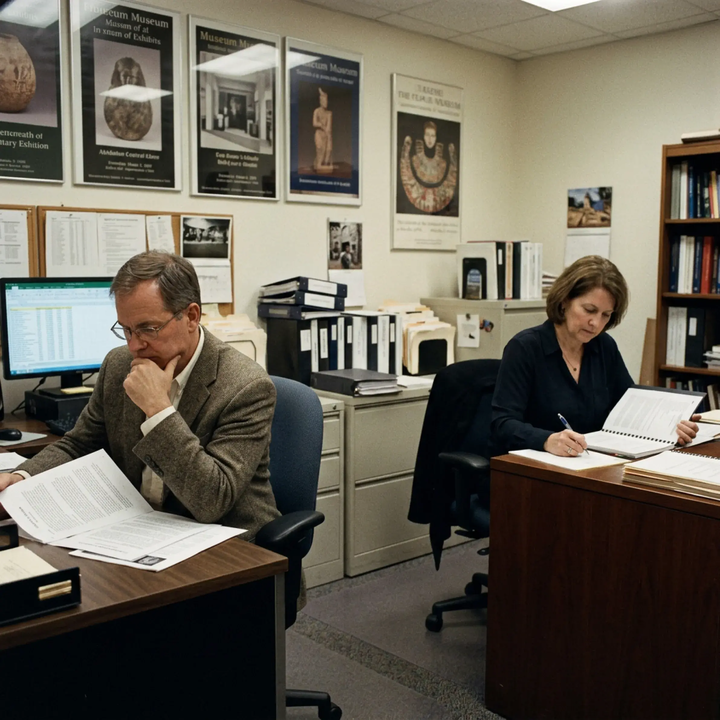
Staff Burnout: The Human Cost
The operational strain doesn’t stay confined to systems. It transfers to people.
Museum professionals rarely enter the field to manage spreadsheets or reconcile transactions. Development teams want to build relationships. Operations teams want seamless visitor experiences. Educators want to expand programming. Finance teams want clarity and control.
Yet manual museum workflows often require skilled staff to spend hours on repetitive data entry, cross-checking, and troubleshooting inconsistencies between tools.
This constant context-switching fragments attention. Fragmented attention drains energy. Over time, that drain affects morale.
When frustration becomes routine, burnout follows. And when experienced staff leave, institutional knowledge leaves with them including the informal workarounds that kept the manual system functioning.
The cost of turnover is rarely attributed to workflow design. But it is often rooted there.
The Visibility Problem: Leadership Flying Blind
As time drains and inconsistencies accumulate, another problem emerges: visibility.
If generating a cross-department report requires days of cleanup, reporting cycles slow. By the time leadership reviews attendance trends, membership performance, or donor activity, the data reflects the past rather than the present.
Strategic questions become harder to answer in real time:
Are memberships trending upward this quarter?
Which programs are driving repeat visits?
How is earned revenue tracking against projections?
What is the organization’s current cash position?
When reporting depends on manual consolidation, leadership decisions are shaped by partial or delayed information.
Reduced museum operations efficiency at the staff level eventually becomes reduced clarity at the executive level.
And without clarity, strategic momentum stalls.
The Compounding Effect Over Time
Manual workflows might function at a small scale. They rarely scale well.
As museums grow; adding exhibitions, educational programs, facility rentals, fundraising initiatives; the transaction volume increases. So does complexity.
But manual systems scale in proportion to labor. Every new program introduces more reconciliation, more documentation, and more coordination between tools.
Seasonal spikes expose the strain most clearly. Summer camps, major exhibitions, year-end fundraising campaigns each surge increases operational pressure.
Without structural efficiency, growth introduces friction instead of leverage.
Manual processes create an operational ceiling. Expansion becomes heavier rather than easier.

Opportunity Cost: What Museums Could Be Doing Instead
The most significant cost of manual museum workflows isn’t just inefficiency or risk.
It’s opportunity.
Time spent stitching data is time not spent personalizing visitor engagement. Energy spent reconciling reports is energy not spent refining development strategy. Manual financial tracking slows proactive forecasting and long-term planning.
When administrative effort dominates the calendar, institutions become reactive. Not because leadership lacks vision, but because operational capacity is constrained by workflow design.
Efficiency isn’t about squeezing more output from staff. It’s about removing friction that shouldn’t exist. Visionary museum operations considerations continued
Signals It’s Time to Rethink Manual Workflows
Manual systems rarely collapse overnight. Instead, they offer warning signs:
Staff rely heavily on spreadsheets to validate system data
Different departments circulate conflicting numbers
Reporting takes days instead of minutes
Burnout conversations center on paperwork and reconciliation
Leadership hesitates to act because data confidence is low
Each sign, on its own, seems manageable. Together, they signal structural inefficiency.
Conclusion: Efficiency Is Not About Working Harder
Manual processes rarely fail loudly. They erode performance gradually.
Improving museum operations efficiency doesn’t begin with working harder or adding another tracking document. It begins with examining how workflows are structured and where duplication, reconciliation, and manual intervention have become normalized.
Reducing manual work isn’t about convenience. It’s about protecting staff capacity, reducing operational risk, preserving reporting accuracy, and enabling sustainable growth.
Before the next major campaign, exhibition launch, or seasonal surge, it may be worth asking:
Where are we relying on manual stitching?
What does that cost us each month?
And what will it cost at twice the scale?