The Reporting Problem Most Museums Don't Realize They Have

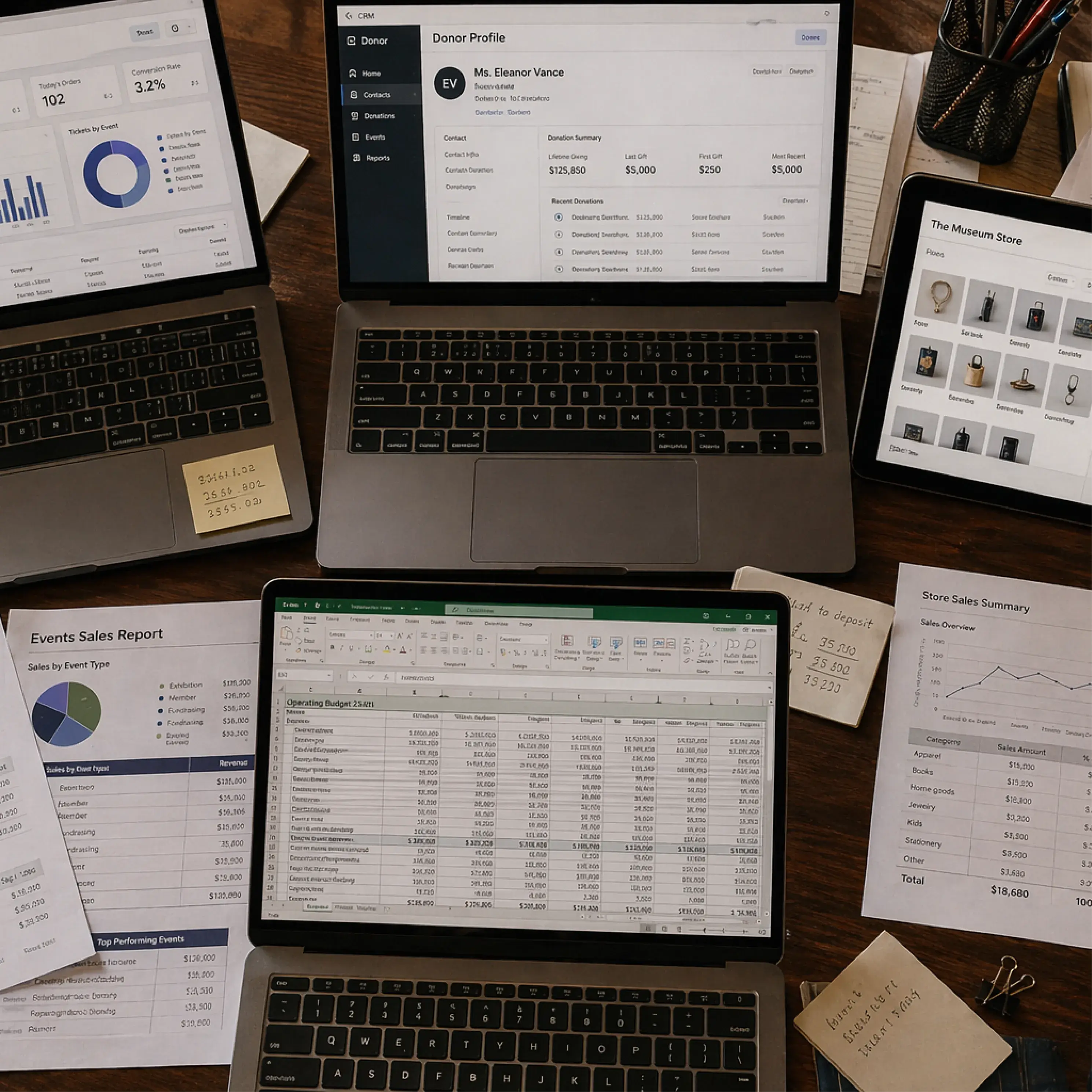
It's 8am. The board meeting is at 10. Your membership manager has her ticketing export open in one tab, the donor database in another, and a spreadsheet she's been building since yesterday afternoon in a third. Two records came back with the same visitor listed under different email addresses. So she made a call on how to process it. Three renewal transactions from last week hadn't synced yet. So she noted it on the report. The attendance figure for the school group visit is sitting in a separate file someone emailed her on Friday. By 9:45 she'll have a report. It will be four pages. It will have taken eleven hours across two days to produce. And the board will receive it as though it arrived fully formed.
The board will receive that report with confidence. Nobody in the room will know it took four hours to build, involved three manual judgment calls, and reflects data that was accurate as of last Tuesday.
This is the reporting problem most museums have. And it isn't visible as a problem because the report exists, the meeting happens, and decisions get made. The machinery behind it is invisible to everyone except the person who built it.
The Part That Actually Costs You
The obvious cost is the time. Several hours per report, multiplied by how often leadership needs data, multiplied by the number of people involved in pulling and reconciling it. In most mid-sized museums, this adds up to a meaningful chunk of someone's week, every week, that is spent moving data between systems rather than using it.
But the time isn't the most expensive part.
The most expensive part is the decisions made on reports nobody fully trusts.
It shows up in the room in ways that feel normal because they've always been there. The development director who opens her membership slide with "these numbers are from Friday, so take them as directional." The executive director who stops mid-sentence during the budget discussion to ask if the October attendance figure includes the school group or not, because she genuinely does not know and it matters. The board member who sends a follow-up email at 6pm asking whether the year-end donor total reflects the matching gift that came in after the export ran. Nobody flags any of this as a problem. It's just how meetings go.
These aren't gotcha questions. They're signals that the people using the data have already internalized that it might be wrong. And when decision-makers don't fully trust their data, one of two things happens: they hedge every decision with qualifiers, or they stop using the data and go with gut. Neither is what a reporting infrastructure is supposed to produce.
Why Museum Reporting Breaks the Way It Does
Museums don't set out to build unreliable reporting. It happens because no one chose this architecture deliberately. The ticketing system came first, because you needed to sell tickets. The membership database came later, from a different vendor, because the ticketing system couldn't handle renewals properly. Donations went into a third platform because that's what the previous development director was familiar with. Retail runs on whatever came with the card reader. Each decision made sense at the time. Together they produce a situation where answering a question like which of our members also donated this year requires touching four systems that have never been introduced to each other.
So the answer gets built by hand. Export from one, export from another, open both in Excel, match on email address and hope the formatting is consistent, handle the thirty-odd records where it isn't, make judgment calls on the ones where the same person appears twice under different names, and arrive somewhere in the vicinity of the truth, with enough uncertainty baked in that the person who built it already knows they will be caveating it in the meeting.
That process introduces error at every step. And the person doing it knows that. Which is why the report gets caveated. Which is why the board asks follow-up questions. Which is why the next report takes just as long to build, because nobody trusts the last one enough to build on it.
The Questions That Never Get Asked
The deeper cost of fragmented reporting isn't the hours or even the accuracy. It's the questions that never get asked because the answer would cost too much to produce.
A development director who knows that pulling a segmented donor list requires two hours of manual work doesn't pull the list for a mid-year check-in. She waits for the campaign. A membership manager who knows that cross-referencing visit history with renewal status requires exporting from three systems doesn't do it monthly. She does it once a year, when she has to.
This means the institution is operating on a fraction of the intelligence it theoretically has access to. The data exists. The question is worth asking. But the cost of assembling the answer is high enough that it only gets asked when the stakes are high enough to justify it, which means most of the time, decisions are being made without it.
The museums that understand their visitors best, renew members at the highest rates, and identify major donors before they lapse are not necessarily the ones with the most data. They're the ones who can ask questions of their data without a two-day project standing between the question and the answer.
What Unified Reporting Actually Changes
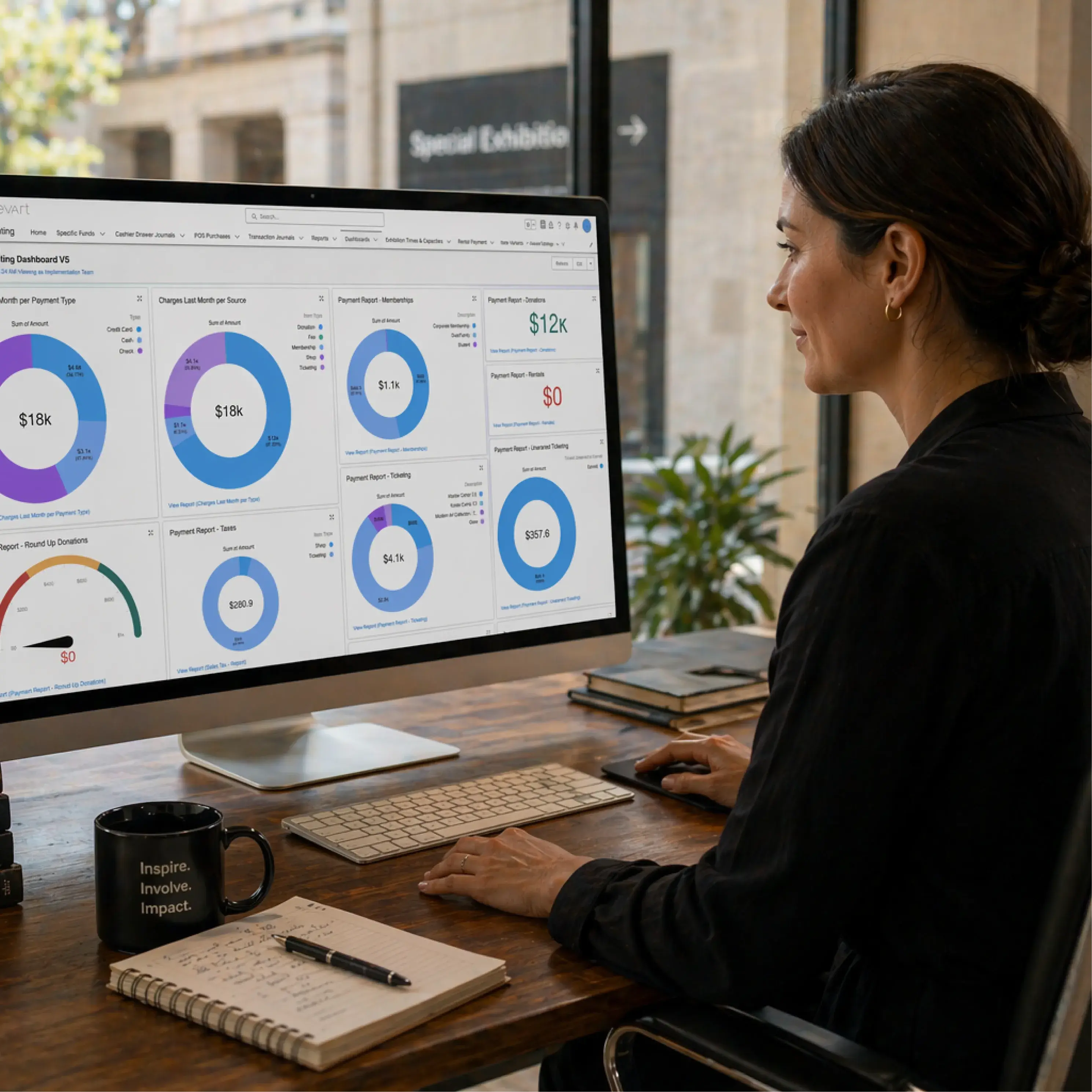
When membership, ticketing, donations, retail, and programs all live in one system, a report isn't an assembly project. It's a query.
The development director who needed four hours to build a board report now runs it in ten minutes, and it reflects data as of this morning, not last Tuesday. The membership manager who checked renewal rates once a year now checks them monthly, because it takes four minutes instead of two hours. The executive director who used to caveat every data point now presents with confidence, because she knows where the number came from and that it hasn't been touched by a manual process since it was recorded.
The questions that used to be too expensive to ask become routine. Which visitor segments are most likely to become members? Which members are showing signs of lapsing before their renewal date? Which programs are driving the most first-time visitors? These are not sophisticated analytics questions; they are basic operational intelligence that most museums technically have the data to answer. The only thing standing between the question and the answer is whether the data is in one place or four.
Unified reporting doesn't give museums new data. It gives them access to the data they already have, without the manual layer that makes it expensive to use and unreliable when they do.
The Caveat That Signals the Problem
If your team regularly qualifies data in leadership meetings, "this is approximate," "there may be some lag," "we will need to verify this," that is not a data literacy problem. That is a data architecture problem.
The caveats are honest. The data probably is approximate. There probably is some lag. Someone probably does need to verify it. But those caveats are also a signal that the reporting infrastructure is not doing what it is supposed to do, which is give leadership a reliable, current picture of what is actually happening in the institution, without a manual reconciliation project standing in the way.
The question worth asking isn't how to build better reports. It's why building a report requires a project at all.
Veevart's unified platform brings your membership, ticketing, fundraising, retail, and programs into one system, so your reports reflect reality, not last Tuesday's export. [Click the "Request a Demo" button to see what reporting looks like when the data is already in one place.]