Ticketing vs CRM: Why Museums Can't Afford to Keep Them Separate
Most museums think of ticketing and CRM as two different jobs.
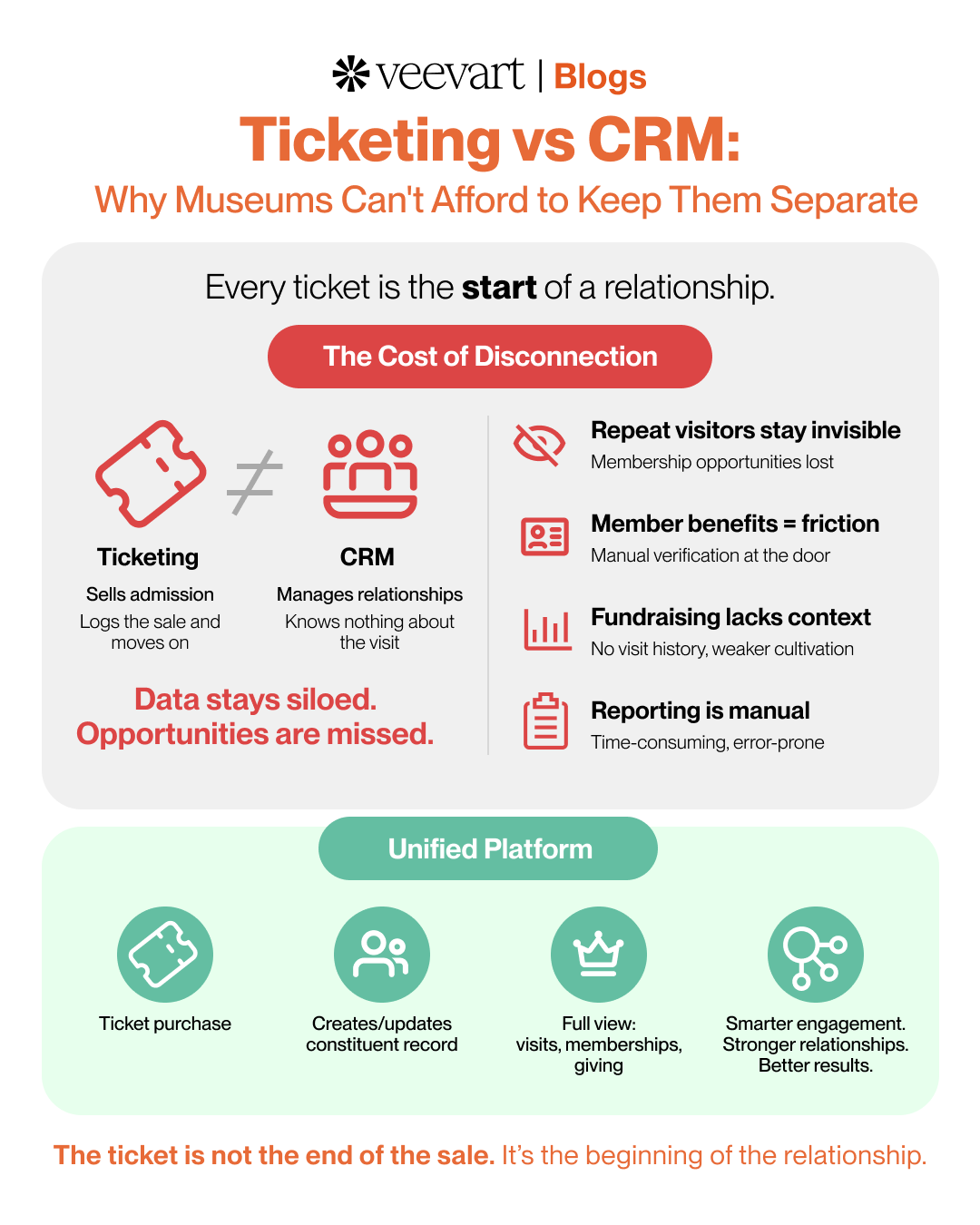
Ticketing sells admission. The CRM manages relationships. The first one takes money at the door. The second one handles the slow work: the donor you've been cultivating for three years, the membership that comes up for renewal in March. Two systems. Two teams. An arrangement nobody questions because it predates everyone currently working there.
The arrangement rests on an assumption that turns out to be wrong: Which is that a ticket is just a transaction.
A ticket is the first thing a visitor does. Before the membership. Before the gift. Before any of it, they bought a ticket. That's where the relationship starts. And in most museums, it starts inside a system built to log the sale and move on. A system with no reason to remember the person once they're through the turnstile.
The Ticket Is the Start of the Relationship, Not the End of the Sale
Think about what a ticket purchase actually tells you.
Who came. When. How often. What they came to see. Whether they brought kids. Whether they booked online the night before or walked up on a whim. Whether they paid full freight or flashed a membership card. For someone visiting for the first time, that purchase is the only thing the museum knows about them. For a regular, it's one more mark in a pattern that's been forming for years.
A ticketing system treats all of that as a sale to be processed. A CRM treats it as a signal about a relationship. The difference isn't semantic. It determines whether the institution can ever act on what it knows.
When the two are separate, that signal gets recorded in the ticketing platform, counted as revenue, and never connected to anything else. The visitor who came four times this year looks identical to the one who came once, because the system that knows the difference doesn't talk to the system that would act on it.
What Separation Actually Costs

A standalone ticketing system does its narrow job well. The cost shows up in everything it can't do because it's disconnected from the rest of the institution's data.
Repeat visitors stay invisible. A person who buys tickets three times in six months is one of the clearest membership prospects a museum has. But if ticketing doesn't feed the CRM, nobody on the membership team ever sees that pattern. The prospect who was ready to be asked never gets asked. (For more on this, see [LINK: Why Museum Membership Programs Stall].)
Member benefits create friction instead of loyalty. When the ticketing system doesn't know who's a member, the discount has to be verified manually at the door, creating a small awkwardness every time, at exactly the moment membership should feel valuable. (See [LINK: Online vs On-Site Ticketing] for what this looks like at the front desk.)
Development works without the engagement picture. A gift officer cultivating a prospect can see giving history, but not visit history. The fact that this person has attended eleven times since their last gift, sits unreachable in the ticketing system. This is probably the strongest signal of engagement there is. (See [LINK: How Ticketing Data Can Drive Museum Fundraising].)
Reporting requires manual assembly. Want to know which visitors convert to members, or which exhibitions bring people back a second time? That's not a report you run. It's an afternoon of exporting two systems and matching them by hand.
Every one of these has the same root. The data is there. It's just trapped in a system that was never built to hand it to anyone else.
Why "We'll Integrate Them" Often Isn't Enough
The common response is to connect the two systems with an integration. The ticketing platform syncs to the CRM on a schedule, and in theory the data flows where it needs to go.
In practice, integrations are often fragile in ways that matter.
They mostly sync on a delay. So the front desk and the CRM can potentially hold different information at the same moment based on this delay.
They break. Whether it’s because of an API change. Or a field mismatch. Or could be due to a failed overnight sync.Often nobody even notices until a report is wrong.
They map data imperfectly. Therefore a membership verified in one system possibly isn't always recognized in the other.
They add cost and maintenance. Requiring someone to monitor and troubleshoot the connection.
An integration treats the symptom. It moves data between two systems that still fundamentally see the world differently. A genuinely unified platform doesn't move the data at all, because the ticket and the constituent record were never separate to begin with. The visitor who buys a ticket is the record. There's nothing to sync.
That distinction of integrated versus unified, is the one that matters most when a museum is evaluating its options.
What Unified Looks Like in Practice

When ticketing and CRM are the same system rather than two connected ones, the relationship and the transaction stop being separate events.
A ticket purchase creates or updates a constituent record automatically. The member buying online is recognized as a member, and the discount applies without anyone verifying anything at the door. The repeat visitor surfaces as a membership prospect without a manual report. The gift officer pulling up a donor sees the full visit history alongside the giving history. The attendance report and the membership conversion report draw from the same data, so they always agree.
None of this requires extra work from staff. It's the natural result of the ticket and the relationship living in one place instead of two.
The museums getting the most from their visitor data aren't the ones with the most sophisticated analytics. They're the ones who stopped treating the ticket as a transaction and started treating it as what it actually is: the beginning of a relationship worth tracking from the first visit.
The Real Question
The framing of "ticketing vs CRM" is itself the problem. It assumes they're two different things that happen to overlap. They aren't. Ticketing is the front door of the CRM, the moment a relationship begins and the institution's chance to start understanding it.
A museum that keeps them separate isn't running two tools. It's throwing away the first and most frequent signal it gets about every person who walks in.
The question worth asking isn't whether to integrate ticketing and CRM. It's why they were never treated as separate systems in the first place.