Five Signs Your Museum Has Outgrown Its Current CRM
Picture a board meeting. The attendance slide goes up, and the number is good. Up eight percent over last year. There are nods around the table with a note of relief. The museum is doing well.
Then one board member asks a question that changes the room. "Up eight percent," she says. "Do we know who those extra people were? Are they coming back? Did any of them become members?"
Silence. Because the attendance number doesn't say. It counts how many people came through the door. It says nothing about who they were. Whether the museum will ever see them again, or whether a single relationship was built in the process.
That question is the subject of this piece. Attendance is the number museums report most and understand least. It's not wrong, and it's not useless. But it hides at least as much as it reveals. An institution that manages the attendance number alone is steering by a gauge that can't see where it's going.

What Attendance Does Tell You
Attendance isn't a bad metric. It's a real signal, and it's worth being clear about what it genuinely captures before taking it apart.
A reliable attendance count tells you:
Reach. How many people the institution drew in a given period, which matters for relevance, for funders, and for the simple question of whether anyone is coming.
Trend direction. Whether that reach is growing or shrinking over time, which is a legitimate early signal of health or trouble.
Response to programming. Whether a new exhibition, a marketing push, or a program drew a crowd, measured against the baseline.
Operational demand. How many people the building and staff need to handle, which is essential for planning.
These are real and useful. The problem isn't that attendance measures the wrong thing. It's that it measures one thing, and institutions treat it as if it measured everything.
What Attendance Hides
Here's where the boardroom question bites. A single attendance number flattens an enormous amount of information that matters more than the total.
It hides who came. Ten thousand visitors could be ten thousand first-timers who will never return, or two thousand deeply engaged regulars visiting five times each. Those are two completely different institutions with the same attendance number, facing completely different futures.
It hides whether they came back. Attendance counts visits, not visitors. A museum can post rising attendance while its actual audience shrinks. If the same declining base of people are simply visiting more often,then the total goes up while the foundation erodes.
It hides what the visit was worth. A visitor who comes once and leaves is counted the same as one who joins as a member on the way out. The attendance number treats a transaction and the start of a relationship as identical events.
It hides the conversion story. The most important question in the building is how many visitors are moving toward membership, giving, and deeper engagement. An attendance total alone can't answer that. You can grow attendance every year and convert no one.
It hides the warning signs. Because attendance aggregates everything into one number, it can stay flat or even rise while the underlying health of the audience deteriorates. By the time a problem shows up in the attendance figure, it has usually been developing, invisibly, for a long time.
The Two-Museum Problem

The clearest way to see the limits of attendance is to imagine two museums that report the identical number.
Both drew 50,000 visitors last year. On the board slide, they look the same.
The first museum's 50,000 is mostly one-time visitors. Few come back. Almost none convert to a membership. The audience is wide and shallow. It has to be fully rebuilt every year through marketing spend, because last year's visitors don't return. This museum is running to stand still.
The second museum's 50,000 includes; a strong core of repeat visitors, a healthy flow of first-timers converting to members, and a membership base that gives and brings others. The audience is deepening. Each year builds on the last rather than replacing it.
Same attendance. Opposite trajectories. One is quietly thriving and one is quietly hollowing out, and the number on the slide cannot tell them apart. That is the core limitation of attendance as a measure of health, and it's why the board member's question matters more than the eight percent.
The Metrics That See What Attendance Can't

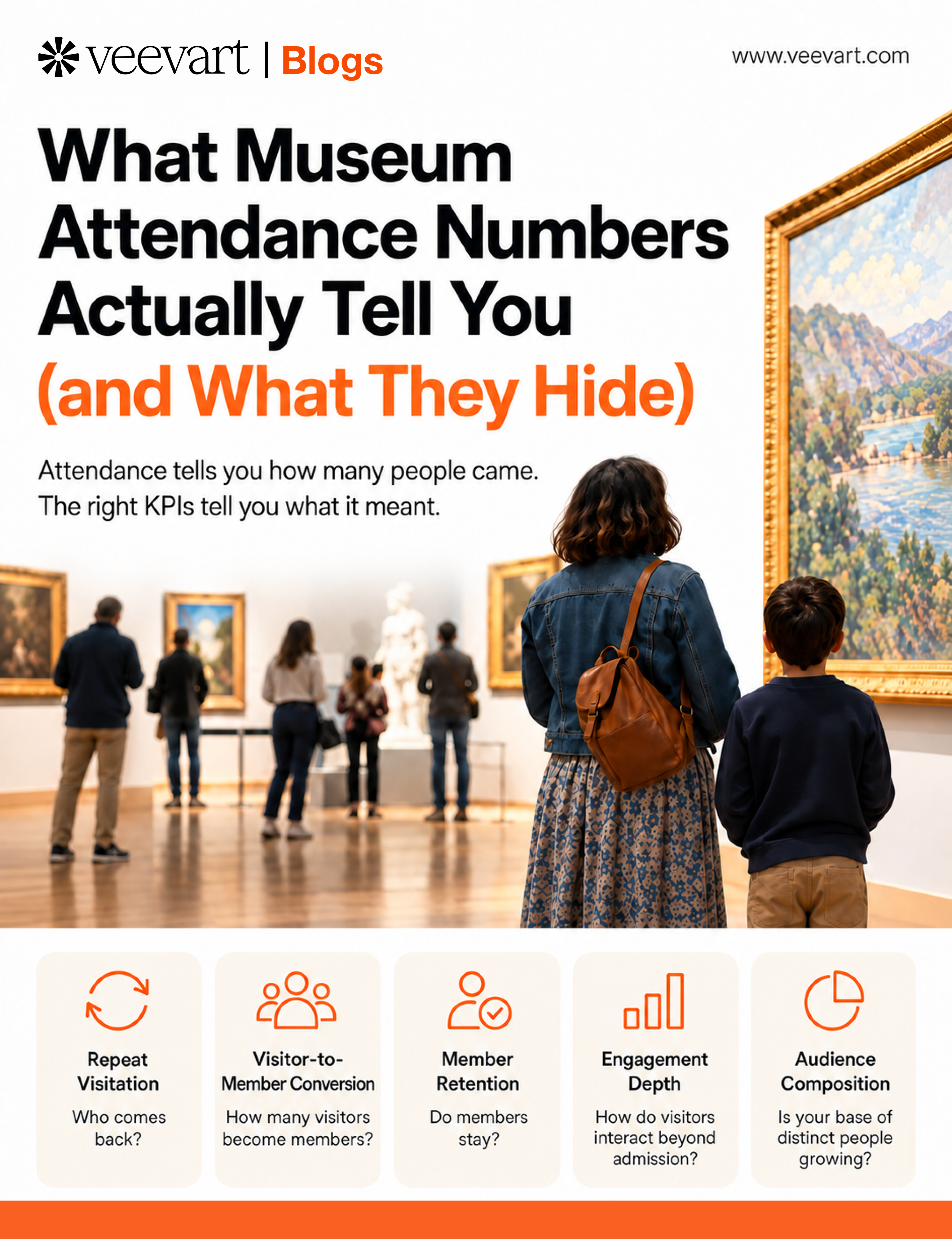
If attendance can't answer the board member's question, then what can? The useful KPI metrics are the ones that describe the relationship and not just the visit.
Repeat visitation rate. What share of visitors come back, which distinguishes a loyal audience from a churning one.
Visitor-to-member conversion. How effectively first-time and repeat visitors become members, the clearest sign the institution is building something lasting.
Member retention and renewal. Whether the members you gain actually stay, which determines whether membership is a growing base or a leaky bucket.
Engagement depth. How many touchpoints a visitor has beyond admission, such as programs, events, and giving, which signals the strength of the relationship.
Audience composition over time. Whether the base of distinct people is growing, not just the count of visits.
None of these replace attendance. They complete it. Attendance tells you how many came. These tell you what it meant, and whether the institution is actually getting healthier or just busier.
Measuring What Matters
The instinct to lead with attendance is understandable. It's easy to count, easy to report, and easy for a board to grasp. But the easiest number to produce is rarely the most important one to understand, and an institution that optimizes for attendance alone can win the metric while losing the mission.
The healthier discipline is to treat attendance as the opening question, not the closing one. How many people came is where the conversation starts. Who they were, whether they'll return, and whether the institution turned any of them into something more is where it should go.
The board member who asked the hard question wasn't being difficult. She was asking the museum to measure what it actually cares about, which was never really the number of bodies through the door. It was the relationships those visits could become. Attendance can't see those. The institutions that learn to measure them are the ones that know, with confidence, whether a good attendance year was actually a good year.
Veevart helps museums see past the attendance total to the relationships underneath it, connecting visits, membership, and giving so the number on the board slide is the beginning of the story rather than the whole of it. See how it works.