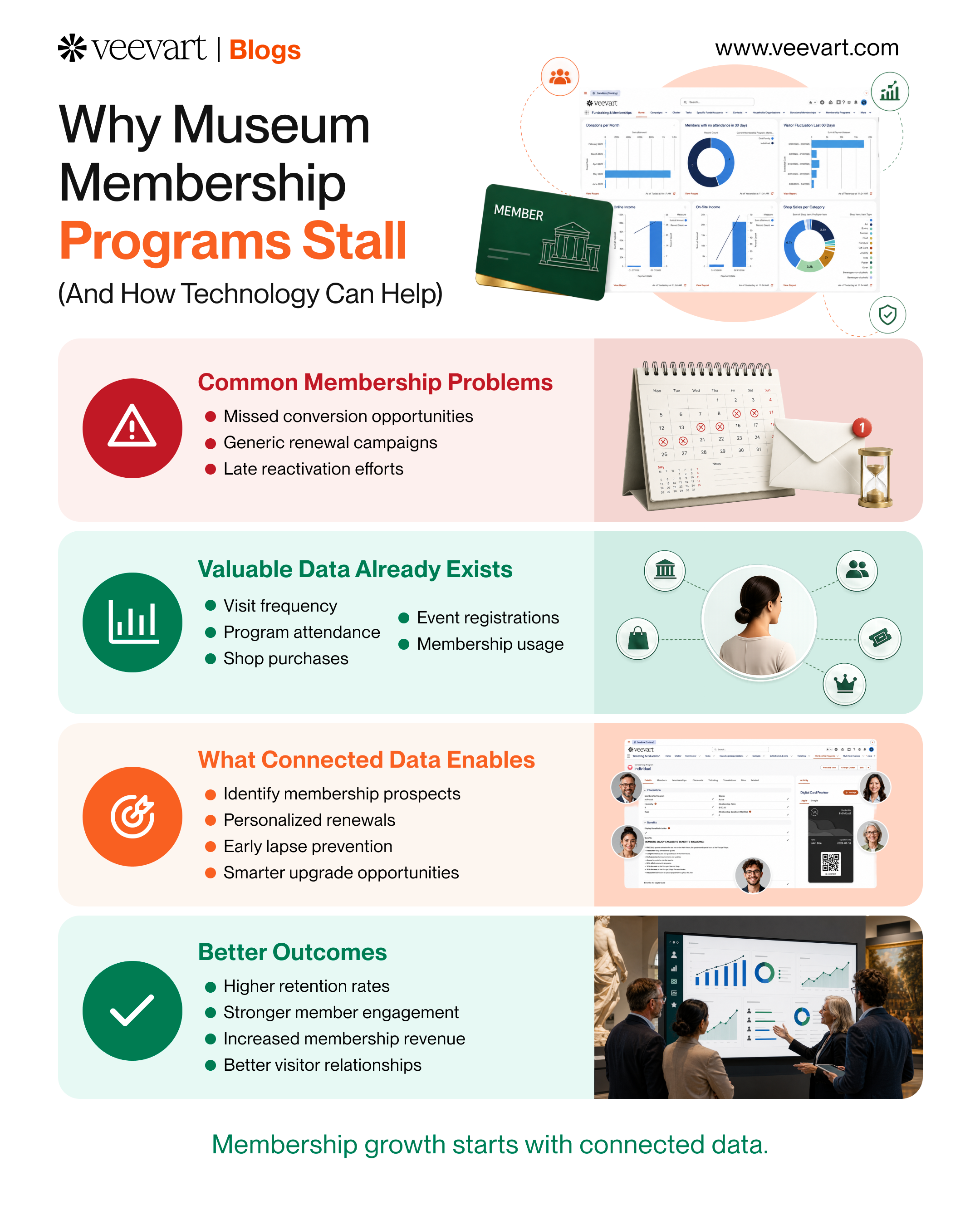
Why Museum Membership Programs Stall (And How Technology Can Help)
The renewal notice goes out sixty days before expiration. Then thirty days. Then a final notice in two weeks. If nothing comes back, the membership lapses and goes into a reactivation campaign six months later. It is a different email, a slightly different offer, and the same uncertainty about whether it will resonate.
This is how most museum membership programs operate. Not exactly this bad, but still based more on a calendar than on actual member behavior. The timing revolves around expiration dates, not around what members are actually doing.
It does not account for whether they have visited twice this month or not at all in the last year. It does not consider whether they just attended three recent programs or whether their engagement has been quietly declining since the fall.
The calendar does not know any of that. And neither does the membership team. Usually, because the data that would tell them is sitting in either the ticketing system, the program registration platform, the POS, or the systems that captured everything the member did. None of this is information is shared with the people responsible for keeping them.
Why Membership Programs Stop Growing

A membership program that is not growing is usually doing one of three things wrong, and rarely knows which one. The problem is that the data needed to diagnose the issue is rarely connected in one place, making it difficult to see what is actually holding growth back.
Conversion is leaking: Somewhere between "first-time visitor" and "member," people are falling out. Not because they did not have a good experience. They did. But the moment they were most likely to join passed without anyone recognizing it or acting on it. A visitor who has come three times in four months and bought tickets to two special exhibitions is behaviorally ready to be asked about membership. If that pattern isn't visible to the membership team, the ask never comes at the right moment. It comes in a generic email six months later, or potentially not at all.
Renewals are treated as administrative events: The renewal notice is a form letter with a deadline. It does not reference what the member actually did with their membership, or the programs they attended, or the exhibitions they saw, or the visits they made. It doesn't differentiate between the member who used their membership twelve times last year and the one who used it once. Both get the same message, the same offer, and the same ask. One of them feels seen. The other one is already deciding if it's worth renewing or not. This matters more than it sounds: industry benchmarks put average museum membership renewal rates between 30% and 45%, with first-year renewals as low as 20% to 35%. The members most likely to slip away are precisely the ones a form letter does nothing to hold onto.
Lapsed members are approached too late and too generically: By the time someone has been lapsed for six months, the window for an easy recovery usually closes. And the math here is unforgiving: reactivation rates run as high as 40% for "freshly inactive" members within the first year, but drop to under 5% once someone has been lapsed for 24 months or more. The reactivation campaign that arrives in month seven is working against a person who has already mentally moved on. The signal that someone was going to lapse was often visible weeks before expiration: declining visit frequency, no program registrations, no shop activity. If that pattern had surfaced earlier, the intervention could have been a personal outreach rather than a mass campaign.
What the Data Already Knows (That the Membership Team Doesn't)
Every member in your database has a behavioral profile that your institution has been building. In many cases, the process begins the moment they buy their first ticket, long before they even realize it.
Visit frequency.
Program attendance.
Exhibition engagement.
Shop purchases.
Event registrations.
Membership benefit usage.
Each of these are a data point indicating how invested this person is in their relationship with the museum. Together they tell a story that a giving history alone never could. Not just what someone has contributed financially, but how deeply they are engaged with the institution and in which direction that engagement is moving.
The difference this makes is measurable. Engaged members renew at rates as high as 60% to 70% and stay roughly four years longer than disengaged members, who tend to drop off sharply after their first year. A member whose visits have increased over the past year, who attended two programs last quarter, and who upgraded their membership tier without being asked is a different conversation from a member whose last visit was eight months ago and who has never used a single membership benefit. The first one might be ready for a major membership upgrade or a first-time giving ask. The second one is at risk of lapsing and needs a different kind of outreach message entirely. One that acknowledges the gap and offers a reason to re-engage before the renewal notice arrives.
Most membership teams know this in theory. The problem is that the data to act on it isn't assembled anywhere. Visit history is in the ticketing system. Program registration is on a separate platform. Shop purchases are in the POS. The membership record in the CRM shows the join date, the tier, the renewal history, and almost nothing about what the member has actually been doing.
So the membership team works the calendar, because the calendar is what they have.
Where Technology Changes the Equation

The argument for integrated membership management isn't about automation replacing relationship-building. It's about giving the people doing the relationship-building the information they need to do it well.
Identifying conversion-ready visitors. When ticketing and membership data share the same system, repeat visitors become visible as membership prospects before anyone has to run a manual report to find them. A visitor who bought tickets three times in six months shows up as a warm prospect. Not because someone researched them, but because the system is looking at the same data the membership team would review if they had time to look at it. The ask arrives at the right moment because the right moment is now visible.
Segmenting renewals by engagement, not just expiration. A renewal campaign built on engagement data looks different from a form letter with a deadline. The member who attended four programs last year gets a renewal message that references what they did with their membership. The member who barely used it gets a message that leads with what they missed, and maybe an offer that gives them a reason to come back before they decide whether to renew. Both messages are based on what the system actually knows about each person. Neither requires manual research.
Catching lapse risk early. When visit frequency, program attendance, and benefit usage are all visible in one place, a member who is trending toward lapse shows up before they lapse. The engagement score drops. The visit pattern changes. That is actionable information. Not for a mass campaign, but for a personal outreach. A phone call or targeted email sent two months before expiration, when a member’s engagement has started to decline, has a far better chance of working. That is very different from sending a reactivation appeal six months after they have already left.The economics reinforce the point: acquiring a new member costs anywhere from 5 to 25 times more than retaining an existing one. Every member you keep from lapsing is worth a multiple of the one you have to go out and replace.
Making upgrade paths visible. The member who is deeply engaged, visiting frequently, attending programs, and donating at the annual fund level is often ready for a higher tier of membership or a first major gift conversation. That readiness is visible in their behavior, but only if the people having those conversations can see the behavior. When membership and engagement data live in the same system as donor records, the development team and the membership team are looking at the same picture. The upgrade conversation happens at the right time because the right time is no longer hidden in a system nobody has access to.
The Membership Program That Runs on Information
For many museums, membership programs run almost entirely on calendar logic. Send the renewal notice. Run the acquisition campaign. Launch the lapsed member appeal. Repeat the cycle. It works well enough to maintain a stable membership base in a stable environment. It doesn't work particularly well when visitor behavior shifts.When a competitive program launches nearby, or when the institution needs membership revenue to grow rather than hold.
The version that grows runs on information. It knows which visitors are ready to join before they've been asked. It knows which members are at risk before they've lapsed. It knows which engaged members are ready for a deeper relationship with the institution. None of that intelligence requires a larger team or a bigger budget. It requires that the data the institution is already collecting, visit history, program attendance, and membership behavior can flow into the hands of the people who can act on it.
Most museums are already collecting that data. The question is whether it's assembled somewhere useful or scattered across systems that don't speak to each other.
Veevart connects your membership program to your ticketing, program registration, and visitor data in one platform, so your team can see who is ready to join, who is at risk of lapsing, and who is ready for a deeper relationship with your institution. [See how it works.]