How Museums Can Turn Everyday Visitor Data into Strategic Insight
Your museum knows more about its visitors than it ever has.
Every ticket sale, every membership, every program signup, every gift shop purchase leaves a record. Multiply that across a year and the institution is sitting on tens of thousands of data points about who comes, what they do, and how often they come back.
And yet, ask a simple strategic question which programs actually bring in new audiences, or which visitors are most likely to become members and the honest answer at most museums is a shrug and an educated guess.
That's the gap this blog piece is about. Not a shortage of data. A shortage of insight. Museums are collecting more than ever and understanding less than they assume, because counting transactions and understanding an audience are two very different things.
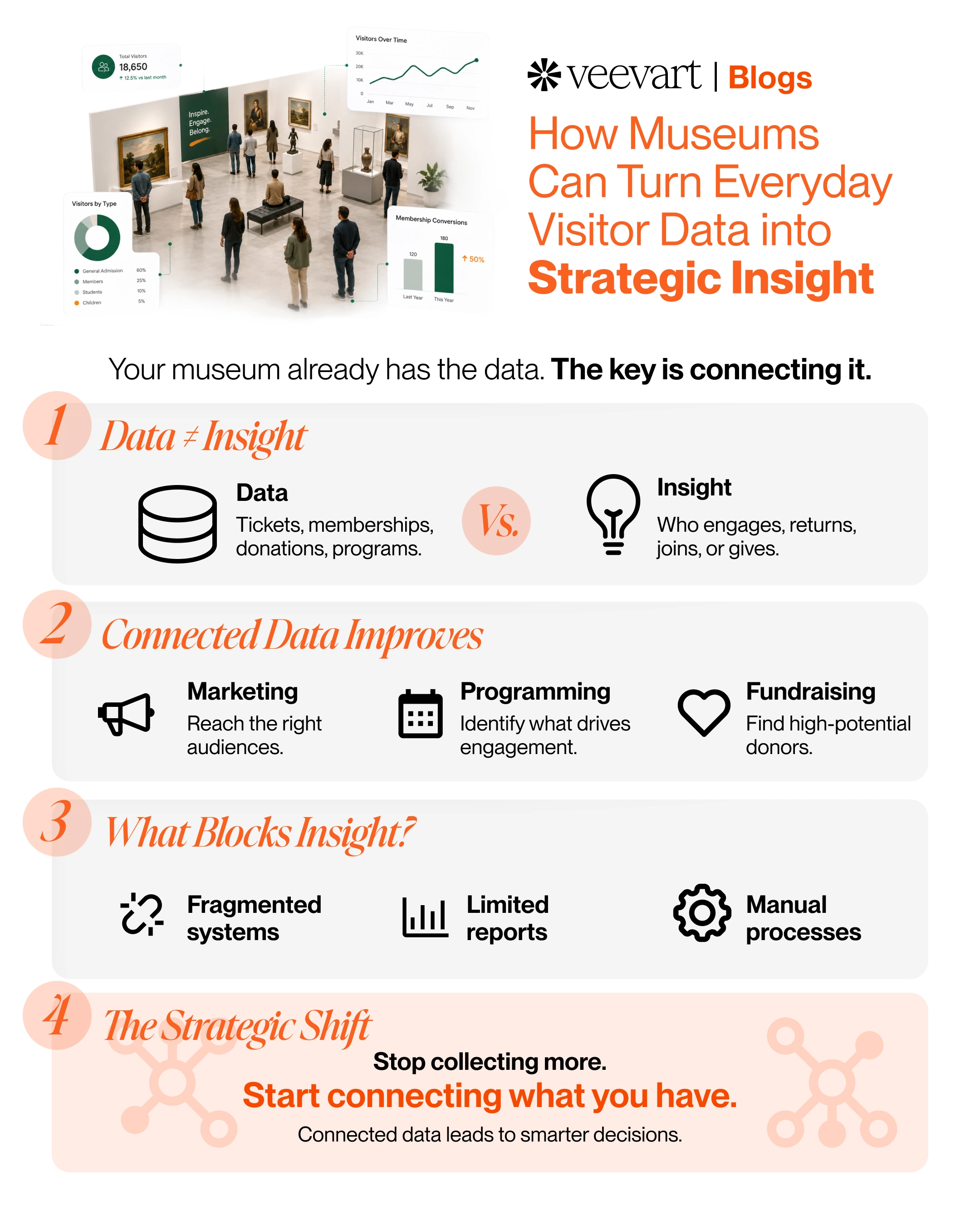
Data Is Not the Same as Insight

It's worth being precise about the difference, because the two get confused constantly.
Data is the raw record: 3,200 tickets sold last month, 140 new members, $18,000 in shop sales. Facts. Countable, reportable, and mostly what a museum's systems produce by default.
Insight is what those facts mean together: that the Thursday lecture series is quietly pulling a younger, non-member audience the rest of your programming isn't reaching, and that this group renews at a higher rate when they do convert. That's not a number you can pull. It's a pattern you have to see.
The trouble is that most museums have plenty of the first and almost none of the second and the reason is structural. Insight comes from connecting data points across a person's whole relationship with the institution. When those data points live in separate systems that don't talk to each other, they can be counted individually but never connected. You can report how many tickets were sold. But you can't easily see that the person who bought them has also attended four programs and never joined as a member.
Counting is easy. Connecting is where the value is. And connecting is exactly what fragmented systems prevent.
What Connected Visitor Data Makes Possible
When ticketing, membership, donations, programs, and retail all feed one connected record, the raw transactions start to resolve into a picture. Three kinds of strategic insight become available that were effectively out of reach before.
Audience insight for marketing. Instead of marketing to a general "visitor" audience, you can see which segments actually behave differently.
Which visitors come once and never return.
Which come seasonally.
Which types of programming pull first-timers versus regulars.
Marketing spend stops being a broad guess and starts targeting the segments most likely to respond.
Programming insight. When program attendance connects to the rest of a visitor's activity, you learn which programs do more than fill seats. You discover which ones bring in new audiences, convert attendees into members, and consistently engage loyal visitors. That's the difference between a program that's popular and a program that grows the institution. (See From Event Chaos to Event Strategy for more on this.)
Development insight. Connected data shows the development team who's engaged, not just who's given. The visitor who has come eleven times, attended three programs, and never made a gift is a cultivation opportunity hiding in plain sight visible only when visit data and donor data live in the same place. (See How Ticketing Data Can Drive Museum Fundraising.)
None of these require new data collection. The data is already being captured. It just has to be connected before it can mean anything.
Why the Insight Stays Locked
If the data already exists, why don't more museums act on it? Three reasons, and none of them are about effort.
The data is fragmented. Visit history in one system, membership in another, donations in a third. No single view of the person exists. So no pattern across their behavior can be seen.
The reports are backward-looking. Most museum reporting answers "what happened last month," not "what's likely to happen next" or "which group should we act on now." It counts; it doesn't guide. (See The Reporting Problem Most Museums Don't Realize They Have.)
The insight costs too much to produce. When answering a strategic question means a two-day export-and-match project. The question gets asked only when the stakes are high enough to justify the effort. Most of the time, the decision gets made without it.
The result is a museum that's data-rich and insight-poor holding the raw material for good decisions, but unable to refine it into something usable at the moment a decision is being made.
From Insight to Strategy

Insight only matters if it changes what the institution does. The point of connecting the data isn't a prettier dashboard. It's better decisions, made earlier, on firmer ground.
A few examples of what that looks like in practice:
A marketing campaign targeting repeat non-member visitors is far more effective than sending a general email blast to everyone.
A programming calendar weighted toward the formats that measurably convert first-time visitors, not just the ones that fill the room.
A development team that reaches out to a deeply engaged non-donor before an annual appeal, because the engagement was visible in the data.
A membership renewal effort that prioritizes the members whose behavior signals they're at risk, rather than treating every renewal the same.
Each of these is a strategic decision that a data-rich, insight-poor museum can't make well and that a museum with connected data can make almost routinely.
The Shift Worth Making
The instinct, when a museum wants to be more data-driven, is to collect more data. Usually that's the wrong move. Most institutions already collect far more than they use.
The shift that matters isn't collecting more. It's connecting what's already there. Turning a pile of separate transactions into a single, legible picture of each person's relationship with the institution. That's the point at which data stops being something you report and starts being something you act on.
Your museum already knows more about its visitors than it ever has. The question is whether that knowledge is assembled somewhere it can guide a decision, or scattered across systems where it can only be counted.