The Hidden Costs of Cheap Museum Ticketing Software
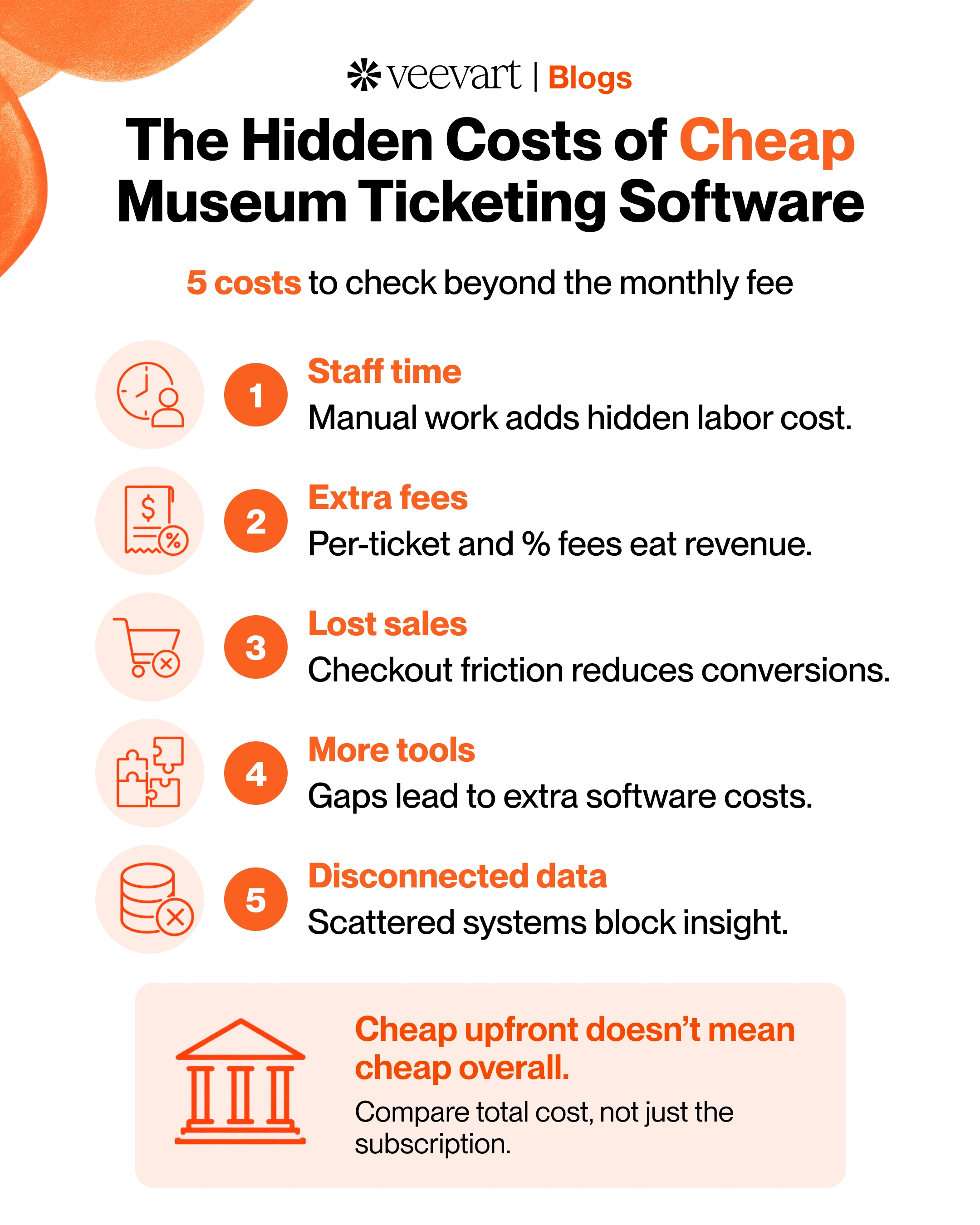
Cheap ticketing software is priced to win one comparison: the monthly fee.
That's the number a budget-conscious institution looks at first, and the low-cost tools are built to look good against it. A modest subscription, perhaps even a free tier, combined with a small per-ticket fee can seem reasonable in isolation. But across an entire organization, those costs add up. On the invoice, it may look like the responsible choice.
The problem is that the invoice is where the cheap option hides its real price. The costs that actually matter, staff time, transaction fees, lost revenue, and the sales you never capture, rarely appear as a line item on the invoice.They're spread across the operation, paid in hours and missed opportunities rather than dollars on a statement. And because they're invisible, the decision looks correct for years while quietly costing more than the "expensive" option ever would have.
For anyone responsible for the budget, this is the case worth understanding before the next renewal.
The Sticker Price Is the Smallest Number

Start with what you're actually comparing when you compare ticketing tools on price.
The subscription fee is visible, fixed, and easy to put in a spreadsheet. It's also, for most institutions, the smallest of the real costs. The larger ones are harder to see mainly because they don't arrive as a bill:
Staff hours spent on manual work the software can't do
Transaction and processing fees that scale with every ticket sold
Revenue lost to conversion friction and missed opportunities
The cost of the other tools you need because the cheap one doesn't do enough
A tool that's cheap on the first line and expensive on the other four isn't cheap. It just moves the cost somewhere the budget doesn't track.
Hidden Cost 1: Staff Time
The most expensive thing about cheap ticketing software is usually the labor hours it creates.
A low-cost tool typically handles the sale and little else. It doesn't sync to your CRM, so someone reconciles the numbers by hand. It doesn't recognize members, so someone verifies discounts manually at the door. It doesn't reconcile against the bank automatically, so someone matches transactions at month-end.
None of this is on the invoice, but it's real money. A staff member spending even a few hours a week on reconciliation and manual workarounds represents thousands of dollars a year in salaried time spent not on advancing the mission, but rather on compensating for what the software won't do. Multiply that across every person touching the system and the "cheap" tool is funding a part-time job's worth of manual labor.
Hidden Cost 2: Transaction Fees That Scale

Most ticketing platforms have transaction costs. The question is how much you're actually paying for each transaction.
A percentage of every ticket sold is already coming out of your revenue to cover payment processing. That's expected. But some platforms add another transaction fee on top of that percentage, creating a second layer of cost that can be easy to overlook when comparing platforms.
The difference between one or two percentage point fees may not sound significant. But across hundreds of thousands of dollars in ticket, membership, and event sales, that percentage difference can become a substantial expense. Then add a fixed fee on every transaction, and the total cost can grow even faster.
This is where a platform that looks inexpensive at the subscription level can become much more expensive in practice. You're not just comparing monthly software costs. You're comparing the percentage of revenue you give up on every transaction, plus any additional fee charged on top of it.
Before choosing the lowest subscription price, look at the total transaction cost: the percentage you pay, the additional per-transaction fee, and your annual transaction volume. A fraction of a percent can make a meaningful difference when you're processing hundreds of thousands or millions of dollars in sales.
.
Hidden Cost 3: Lost Revenue
This is the cost that never appears anywhere, because you can't invoice for a sale that didn't happen.
Cheap ticketing tools lose revenue in quiet ways:
Conversion friction. A checkout that's clunky on mobile, requires an account, or takes too many steps loses a percentage of buyers who simply give up. Every abandoned purchase is revenue the tool potentially cost you.
No upsell path. A tool that can't offer a membership at the point of ticket purchase misses the single best moment to convert a visitor right when they've decided to come.
Invisible visitors. When the ticketing system doesn't feed your CRM, the repeat visitor who was ready to become a member stays invisible, and the membership revenue never materializes. (See: Ticketing vs CRM: Why Museums Can't Afford to Keep Them Separate.)
Lost revenue is the largest hidden cost precisely because it's the hardest to see. There's no statement that shows the members you didn't convert or the carts that were abandoned. But the money is just as gone as if you'd spent it.
Hidden Cost 4: The Tools You Need to Buy Around It

A cheap ticketing tool is cheap partly because it does one thing. Everything it doesn't do, you end up buying separately.
A tool for email marketing, because ticketing can't reach your buyers. A separate membership system, because it doesn't handle renewals. A POS for the shop. A spreadsheet or a second platform for programs. Each has its own subscription, its own learning curve, and its own set of integration headaches. Add them up and the "affordable" ticketing tool sits at the center of a patchwork that costs more in total in money and in the staff time to hold it together than a single unified system would have.
This is the fragmentation trap. The cheap tool doesn't just fail to unify your operation. It's the reason your operation is fragmented in the first place. (See: Why Museum Data Lives in Too Many Places.)
How to Actually Compare Cost
The right comparison isn't subscription against subscription. It's total cost of ownership against total cost of ownership. Before choosing a ticketing system or renewing a cheap one account for the full picture:
The subscription fee, annually
The transaction fees, against your real ticket volume
The staff hours spent on manual work the tool creates, valued at actual salary cost
The revenue lost to conversion friction and missed upsells
The cost of every additional tool required to fill the gaps
Run those numbers and the cheap option frequently turns out to be the expensive one. A system that costs more per month but eliminates the manual labor, captures more revenue, and replaces three other subscriptions can be dramatically cheaper in total while also being better.
The Real Cost Question
Cheap software isn't a bargain if it costs you staff time, transaction fees, lost revenue, and a patchwork of other tools to function. It's a decision that looks responsible on the invoice and expensive everywhere else.
For anyone accountable for the budget, the useful question isn't "what's the cheapest ticketing tool." It's "what's the tool that costs the least across everything it touches." Those are rarely the same answer and the gap between them is money the institution could be spending on its mission instead.
Veevart replaces the patchwork with one platform ticketing, membership, fundraising, retail, and programs together, so the hidden costs of a cheap tool stop draining the budget you were trying to protect.