Timed-Entry Ticketing for Museums: When It Helps and When It Backfires
For a few years, timed entry stopped being a choice.
Museums adopted it out of necessity, when capacity limits and distancing rules made controlling the number of people in a building a requirement rather than a strategy. It worked. Crowds thinned, entry staggered, and institutions discovered they could manage visitor flow in ways they never had before.
Then the necessity passed, and a lot of museums kept timed entry without ever asking whether it still served them. It had become the default. A best practice nobody questioned and is running quietly in the background of the ticketing system.
That's worth questioning. Timed-entry ticketing is not a universal good or a universal burden. It's a tradeoff. It solves real problems and creates new ones. Whether it's right for your institution depends on what you're actually trying to manage. This guide is an honest accounting of both sides.
What Timed Entry Actually Does
Timed-entry ticketing assigns each visitor a specific arrival window rather than admitting everyone whenever they show up. Instead of an open door and an unpredictable crowd, you get staggered entry across the day.
That single change affects a surprising number of things:
Capacity management becomes precise: you know how many people will be in the building in any given window
Visitor flow smooths out which can reduce the bottlenecks that form when everyone arrives at once
Queue management improves, because the line at the door spreads across time slots instead of piling up at opening
Staffing can be planned against known demand rather than guessed at
These are real benefits. For the right institution, they're transformative. The question is whether your institution is the right one.
When Timed Entry Helps

Timed entry earns its place in specific conditions. If several of these describe your museum, it's likely doing real work for you.
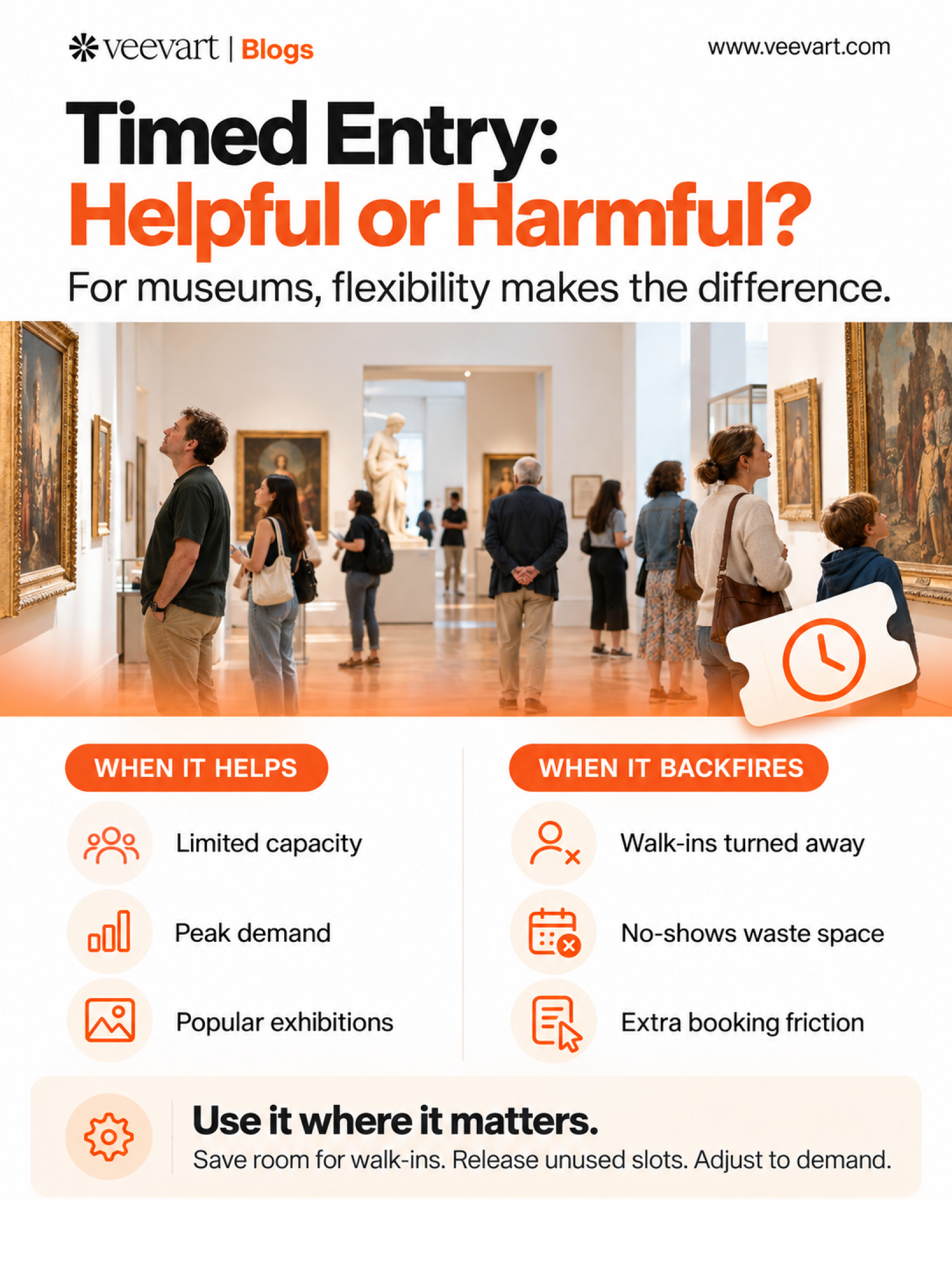
You have genuine capacity constraints. If your galleries have a real physical limit, such as a popular special exhibition, a small space, or a fire-code ceiling you actually hit, timed entry is the cleanest way to stay within it without turning people away at the door.
You experience sharp demand peaks. If visitors cluster at predictable times, such as weekend mornings or the first Saturday of a new exhibition, spreading them across staggered windows protects the visitor experience and your staff's sanity.
A blockbuster exhibition is driving an unusual volume. High-demand ticketed shows are the textbook case. Timed entry lets you sell to demand while protecting the experience inside the gallery, and it gives you clean data on exactly when people want to come.
You need to protect dwell time. When a space is overcrowded, visitors move through faster and engage less. Managing entry keeps the galleries at a density where people actually linger, and dwell time is one of the truer measures of whether a visit landed.
You want the planning data. Timed entry generates precise information about when people visit, how far in advance they book, and how demand distributes across the week. That data has value well beyond the door.
When Timed Entry Can Become A Hindrance

Here's the side that gets left out of most discussions, because it's less convenient. Timed entry can have real costs, and for some museums they outweigh the benefits.
It turns away walk-in visitors. This is the big one. A significant share of museum visitors don't plan ahead. They're tourists with an open afternoon, or a family that decided over lunch, or someone passing by. A rigid timed-entry system can turn these walk-in visitors away when a slot is "full," even if the building isn't. You lose the admission, the potential membership, and the goodwill…all at once.
No-shows quietly waste capacity. Timed-entry reservations, especially free ones, can carry a no-show rate that can be high. If your system counts a reserved-but-unclaimed slot as full, you're turning away real visitors to hold space for people who never arrive. Without a way to release or overbook against no-shows a timed entry can leave you simultaneously "sold out" and potentially half-empty.
It adds friction for the spontaneous visitor. Requiring a reservation asks visitors to plan a visit they might have made on impulse. For a major exhibition people are determined to see that friction is acceptable. For general admission on a quiet Tuesday, it can suppress the casual visit that would have happened otherwise.
It creates operational overhead. Someone has to manage the slots as well as any changes. They also have to manage the no-shows and the walk-ups who don't understand why they can't just come in. If your ticketing system doesn't handle staggered entry gracefully, that overhead lands on your front-desk staff, at the door, in front of the visitor.
It can misfire when demand doesn't warrant it. If your museum rarely hits capacity, timed entry solves a problem you don't have, while introducing all the friction and none of the benefits. Managing entries you don't need to manage is pure cost.
The Real Question Isn't Whether. It's How.
The mistake most museums make with timed entry isn't choosing wrong. It's treating it as all-or-nothing: either the whole institution runs on rigid timed slots, or it doesn't use them at all.
The institutions that get the most from timed entry use it selectively and flexibly:
Timed entry for the special exhibition, open admission for the permanent collection, so you manage the genuine constraint without adding friction where there isn't one
Held capacity for walk-ins, so a share of each window stays available for the visitor who didn't plan
Overbooking against known no-show rates, so unclaimed slots don't waste real capacity
Staggered entry that adjusts to actual demand rather than a fixed grid applied regardless of the day
None of this is possible with a blunt system that only knows how to sell a slot or refuse one. It requires flexible ticketing that can hold some capacity for walk-ins, release no-shows, apply timed entry to one exhibition but not another, and adjust as the day actually unfolds.
What This Requires From Your Ticketing System
The difference between timed entry that helps and timed entry that backfires often comes down to how much control your ticketing system gives you.
A rigid system forces the all-or-nothing choice. It sells a slot or it doesn't. It can't easily hold walk-in capacity, can't overbook intelligently against no-shows, and can't apply different rules to different parts of the museum. When timed entry backfires, the system's inflexibility is usually the reason.
A capable system treats timed entry as one tool among several, applied where it helps and withheld where it doesn't. It manages capacity per exhibition, protects a share of each slot for walk-ins, tracks no-show patterns and lets you plan around them, and reflects real-time availability across online and on-site sales so a slot is never sold twice or held empty by mistake. (On why online and on-site need to share one real-time inventory, see Online vs On-Site Ticketing.)
The takeaway isn't that timed entry is good or bad. It's that timed entry is only as good as your ability to control it, and that control lives in the ticketing system underneath.
Deciding for Your Museum
Timed entry is a strategy, not a default. Before keeping it, adopting it, or dropping it, ask what you're actually trying to manage.
If you have real capacity constraints, sharp demand peaks, or a blockbuster driving unusual volume, timed entry is probably serving you, and the goal is to run it flexibly enough to protect walk-ins and account for no-shows. If you rarely hit capacity and your visitors tend to arrive on impulse, a rigid timed-entry system may be quietly costing you visits it was never needed to prevent.
The right answer is specific to your institution, your space, and your visitors. The wrong answer is keeping a system running out of habit because it was necessary once and nobody has questioned it since.
Veevart's ticketing handles timed entry as a flexible tool, not a blunt instrument. Manage capacity by exhibition, hold space for walk-ins, plan around no-shows, and keep online and on-site ticketing drawing from one real-time inventory. See how it works for your museum.