What to Look for in Museum Fundraising Software (Beyond a Donation Form)
Most tools that call themselves fundraising software, are underneath a donation form.
They give you a branded page where a supporter enters an amount and a card number. The gift processes, a receipt goes out, and the money lands in your account. That's genuinely useful. It's also the smallest part of what fundraising actually is.
Here's the mistake a museum makes when shopping for fundraising software. It evaluates the part it can see which is the donation form. Or the checkout flow. Or the branded page. Ultimately you end up with a tool that collects gifts, but can't help raise them. Mainly because raising money isn't a transaction. It's a relationship that is sustained over years. A form in its own right has no idea who the person filling it out is or what they mean to the institution.

This is a guide to what actually matters when choosing a museum fundraising software. Once you look past the donation form to the work of fundraising itself.
The Difference Between Processing a Gift and Raising Money
Start with the distinction that shapes everything else.
Processing a gift is a single moment: someone decides to give and the software handles the transaction. Raising money is the long work around that moment. It's knowing who to ask, when to ask, and for how much. It's stewarding the donor afterward so they give again. It's recognizing the visitor who has quietly attended eleven times and never been asked. A donation form handles the moment. It does nothing for the work around it.
The software that actually helps a museum raise money is built around the donor relationship, not the donation event. That's the lens to evaluate against. Every capability below matters to the degree that it serves the relationship, not just the transaction.
What to Look For

Here is what separates real fundraising software from a donation form with a logo on it.
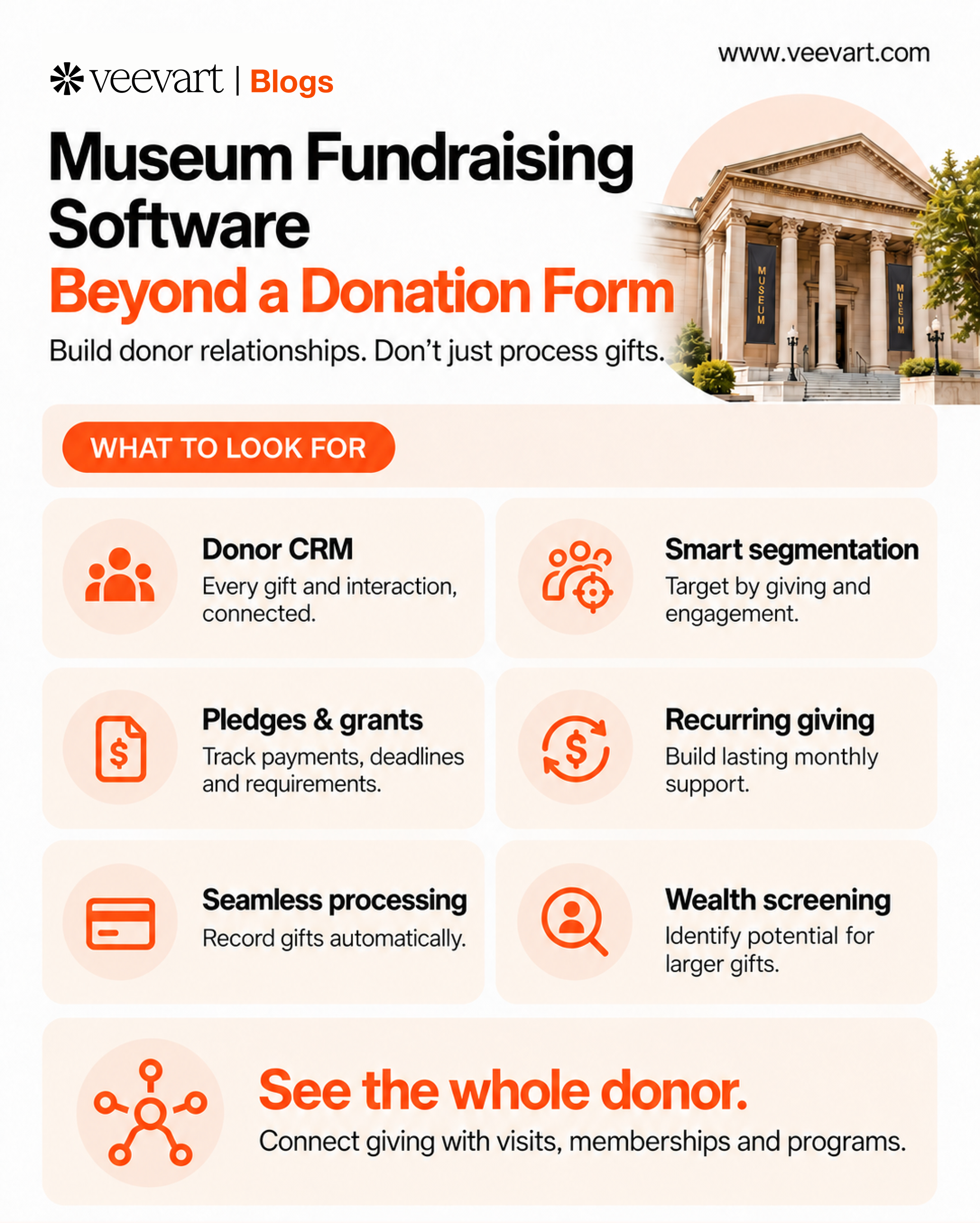
A genuine donor CRM underneath. The foundation of fundraising software isn't the form. It's the donor record behind it: a complete history of every gift, every interaction, every touchpoint, tied to one person over time. Without that, you could be processing transactions blind. With it, every ask is informed by what you actually know about the donor. If the tool's donor record is thin, then the tool is a payment processor.
Donor segmentation that reflects real behavior. You can't send the same appeal to everyone and expect results. Effective fundraising software lets you segment donors by giving history, engagement, capacity, and interest, so the right message reaches the right group. Segmentation is only as good as the data behind it, which is why it matters that the fundraising tool connects to the rest of what the institution knows about each person.
Pledge tracking. Major gifts are often made as pledges paid over time. If software can't track the pledge, payment schedule, payments, and remaining balance, development staff are forced back into spreadsheets. That creates unnecessary work for the gifts that matter most. Pledge tracking is a basic test of whether a tool was built for real fundraising or just one-time online gifts.
Recurring giving. Sustainer programs are among the most valuable things a museum can build, because recurring donors give more over time and cost less to retain. Fundraising software should make recurring giving easy to set up, manage, and report on, and should treat a monthly donor as an ongoing relationship rather than twelve separate transactions.
Grant tracking. For many cultural institutions, grants are a significant share of contributed revenue, with their own deadlines, requirements, and reporting obligations. Software that tracks the grant pipeline alongside individual giving keeps the full development picture in one place instead of scattering it across systems.
Donation processing that fits your operation. The transaction still matters. Look for flexible donation processing that supports one-time and recurring gifts, works seamlessly on mobile, and can be tied to specific campaigns and appeals. Most importantly, every gift should be recorded automatically on the donor’s record, without requiring staff to reconcile it later.
Wealth screening or the ability to use it. Understanding a donor’s capacity to give helps development teams prioritize their efforts. Fundraising software should help identify donors who may be capable of a larger gift, either through built-in tools or integration with a wealth-screening service. This allows development teams to focus their cultivation efforts where they can have the greatest impact.
The Capability That Ties It All Together

Every item above shares a dependency, and it's the thing most easily missed in an evaluation.
Fundraising software is only as powerful as the data it can reach. A donor CRM that only knows about donations is working with half the picture. It can tell you what someone gave. It should show you when someone is visiting monthly, attending multiple programs, and renewing their membership at a higher tier. Together, these behaviors can signal the kind of growing engagement that often precedes a major gift.
That fuller picture only exists when fundraising data connects to the rest of the institution's data: ticketing, membership, programs, retail. When it does, the development team can see engagement, not just giving, and the difference in the cultivation conversation is significant. (This is explored in depth in How Ticketing Data Can Drive Museum Fundraising.)
So the most important question to ask about any fundraising tool isn't about the donation form at all. It's whether the tool sees the whole donor or just their gifts.
Questions to Bring to a Demo
When you evaluate fundraising software, the donation form will look fine. It always does. These are the questions that reveal what's underneath.
Show me a complete donor record. Does it include engagement beyond giving, or only gift history?
How does the system handle a multi-year pledge with a payment schedule?
Can I segment donors by both giving history and engagement behavior?
Does a gift made through the form record against the donor's record automatically, or does someone reconcile it later?
How does recurring giving work, and how is a sustainer donor represented over time?
Can I track grants and their requirements alongside individual giving?
Does the fundraising data connect to our ticketing, membership, and program data, or does it live on its own?
The answers separate software built for fundraising from software built for donation collection. The two look identical on the surface and behave nothing alike in practice.
Choosing for the Work, Not the Form
A donation form is easy to evaluate and easy to be impressed by. It's also the part of fundraising software that matters least to whether your institution actually raises more money.
The tools that move the needle are the ones built around the donor relationship: a real CRM underneath, segmentation that reflects behavior, pledge and grant tracking, recurring giving, and above all a connection to the full picture of who each donor is to the institution. Choose for that work, and the donation form takes care of itself. Choose for the form, and you get a system that collects gifts efficiently while leaving the actual fundraising to spreadsheets and memory.
The right question isn't "how good is the donation form." It's "does this software help us raise money, or just process it." (For the broader evaluation framework, see The Complete Guide to CRM for Museums and Cultural Institutions.)
Veevart brings fundraising together with ticketing, membership, and programs in one platform, so your development team sees the whole donor, not just their gift history. Pledges, recurring giving, grants, and segmentation, connected to everything else the institution knows.