Why Generic CRM Fails Cultural Institutions
On paper, a generic CRM looks like the sensible choice for an arts organization.
Tools like HubSpot and Zoho are powerful, well-supported, and widely used. Several offer nonprofit discounts or free tiers. A budget-conscious museum or cultural institution looks at the price, the brand recognition, and the vast ecosystem of support, and reasonably concludes: why pay for something specialized when these industry-standard tools are right there?
The answer isn't about features, at least not at first. It's about a deeper mismatch, one built into the fundamental design of what these tools are for. A sales-oriented CRM and a cultural institution have incompatible ideas of what a relationship is. And that incompatibility doesn't show up in a demo. It shows up six months in, when the institution is fighting its own system every day.
This is why a generic CRM so often disappoints arts organizations, even when the tool itself is well-made.

A Sales CRM Is Built to Close a Deal
To understand the mismatch, start with what a sales CRM is actually designed to do.
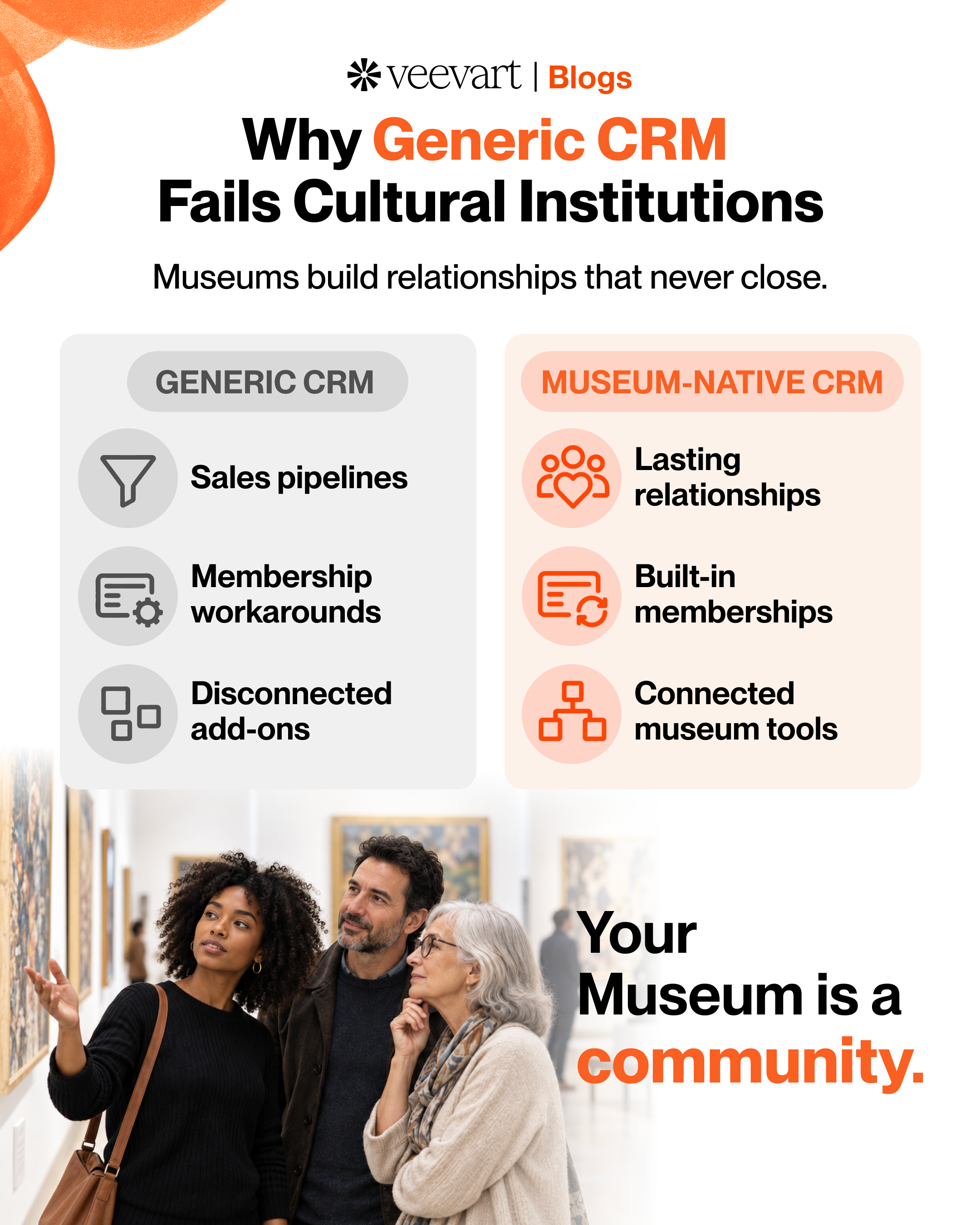
Most mainstream CRMs are organized around a pipeline. A lead enters at one end. It moves through defined stages: contacted, qualified, proposal, negotiation. And it exits at the other end in one of two states: won or lost. The entire data model, including the reporting, automation, and core logic, is built to move opportunities toward a close and then measure how many closed.
This is a brilliant design for selling. It's a category error for a museum.
A cultural institution's relationships don't close. They begin, deepen, lapse, revive, and continue, often across decades. The first-time visitor becomes a member. The member becomes a donor. The donor brings their grandchildren, who become the next generation of visitors. There is no "won." There is no "lost." There is only an ongoing relationship that changes shape over time.
When you put that relationship into a system built around a pipeline, the system asks the wrong question about every person in it. It wants to know: has this deal closed? The institution needs to know something entirely different: how is this relationship doing, and where is it heading?
What Breaks When the Model Doesn't Fit

The pipeline mismatch isn't abstract. It produces specific, daily friction in an arts organization trying to run on a generic CRM.
The core objects are wrong. A sales CRM thinks in leads, opportunities, and accounts. A museum thinks in members, donors, visitors, households, and constituents. Forcing one vocabulary onto the other means constant translation and custom configuration just to describe the people you serve.
Recurring relationships don't fit. A membership that renews every year isn't a series of separate deals; it's one continuous relationship. A pipeline built to close opportunities has no natural way to represent something that recurs indefinitely, so it gets forced into workarounds.
The museum functions simply aren't there. Ticketing, membership tiers, event registration, facility rentals, gift shop POS, and collections, none of these exist in a generic CRM. Each has to be built, bought as an add-on, or bolted on through a third-party integration. Each addition reintroduces the fragmentation the CRM was supposed to solve.
Reporting answers sales questions. Out of the box, the reports focus on pipeline velocity, win rates, and deal size. The questions a museum actually asks are different: renewal rates, visitor conversion, donor engagement, attendance trends. Answering them requires rebuilding the reporting layer from scratch. Each of these is solvable with enough customization. That's exactly the problem. To make a general-purpose tool behave like something it was never designed to be, the institution ends up paying, in configuration, admin time, and permanent complexity..
Configuration Is Not the Same as Fit
The common counterargument is that any flexible CRM can be customized to do what a museum needs. Technically, that's often true. Practically, it misunderstands the cost.
Customizing a general-purpose CRM into a museum system means someone has to design the membership logic, build the ticketing workflow, configure the reporting, and connect whatever functions the base tool can't handle. That someone is either an in-house expert the institution has to hire and keep or brings on an outside consultant the institution has to keep paying over time. And the result is a custom build. Which means every future change, every upgrade, and every new staff member's training depends on understanding a configuration that exists nowhere else and is documented, if at all, in one person's head.
A tool that can be configured to fit is not the same as a tool that fits. The gap between those two is measured in years of cost and complexity.
What "Museum-Native" Actually Means

The alternative to a generic CRM is a system whose fundamental model already matches how a cultural institution works.
A museum-native CRM thinks in constituents, not leads. It treats a membership as a recurring relationship, not a closed deal. It has ticketing, fundraising, retail, and programs as native functions rather than integrations. And it reports on the questions museums ask, because those questions were the design brief, not an afterthought.
The difference isn't cosmetic. When the system's model matches the institution's reality, the software supports the work instead of fighting it. Staff stop translating their world into sales vocabulary. Workarounds stop accumulating. The data stays connected, because it was never designed to be separate. (For more on why that connection matters, see Ticketing vs CRM: Why Museums Can't Afford to Keep Them Separate.)
None of this requires giving up the reliability of an enterprise platform. The strongest museum-native systems are built on proven, secure infrastructure. They simply add the cultural-sector layer that a general-purpose tool leaves to the institution to construct on its own. (For the full comparison of approaches, see The Complete Guide to CRM for Museums and Cultural Institutions.)
The Real Lesson
The failure of generic CRM in cultural institutions isn't a failure of the tools. General-purpose CRMs are excellent at what they were built for. The failure is one of fit, using a tool designed to close sales to manage relationships that never close.
An arts organization doesn't have a pipeline. It has a community. And software built to move deals toward a close will always, at some fundamental level, misunderstand a museum's relationship with the people it serves.
The right question for an arts organization isn't "which CRM is most powerful." It's "which system was actually built for the kind of relationships we have." Those are rarely the same answer, and the difference is felt every day the software is in use.