Five Signs Your Museum Has Outgrown Its Current CRM
Most museums don't replace a CRM because it broke. They replaced it because they slowly realized it had been holding them back for years.
That's the hard part. A system that's genuinely limiting your institution rarely announces itself. It just quietly makes everything a little harder, reports take longer, data doesn't quite match, and staff build their own workarounds until "that's just how it works here" becomes the accepted truth. The cost is real, but it's spread thin enough across the week that nobody adds it up.
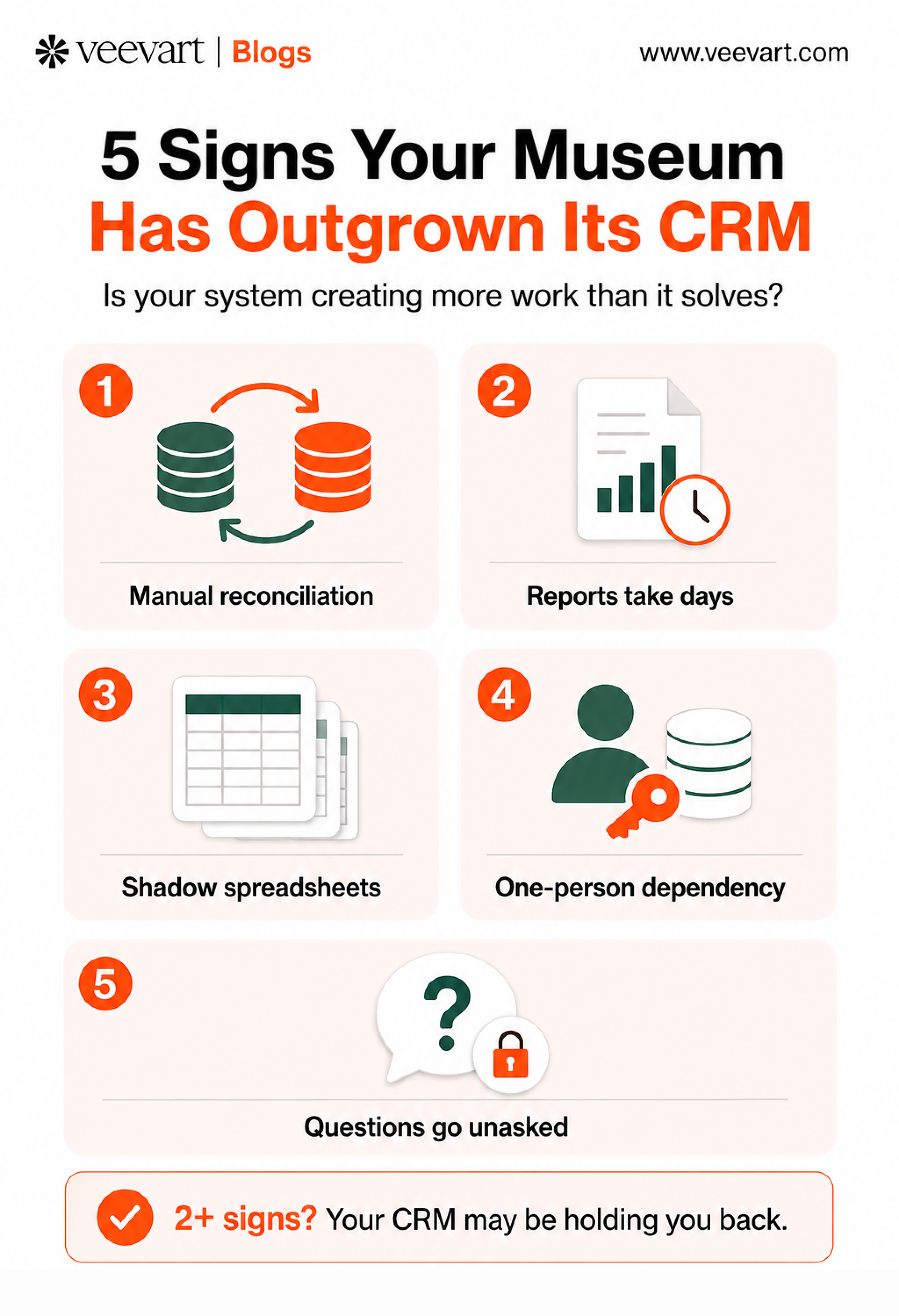
Here are five signs that the system is the problem, not the people using it. If more than one sounds familiar, the cost of staying may already be higher than the cost of switching.
1. Reconciling Data Between Systems Is Part of Someone's Weekly Routine
Somewhere in your museum, someone starts the week by making systems agree. Exporting membership numbers from one place, ticketing from another, then matching them by hand, and finally resolving the records that don't line up.
If reconciliation is a recurring job rather than a rare exception. Well that's the first sign. A CRM that fits an institution doesn't require anyone to manually stitch it to the other systems the data is already connected to. Industry data suggests museums spend anywhere from 30 minutes to 3 hours a day on reconciliation when systems are fragmented. That's a standing tax on staff time that exists purely because the tools don't talk to each other.
The tell: if a key staff member left tomorrow, would anyone else know how to reconcile the numbers? If the answer is no, the system has become dependent on a person instead of the other way around.
2. Pulling a Basic Report Is a Project, Not a Query

Ask your team a few straightforward questions. Which members donated this year? Which visitors came more than twice this year? Watch what happens.
If the answer to both questions are, "give me a couple of days." The CRM has outgrown its usefulness. In a system that fits, questions like these are a filter you can easily apply and an answer comes minutes. When it becomes an export-and-match project, it means the data lives in pieces the CRM can't assemble on its own.
The deeper cost isn't the time. It's that reports this expensive to produce simply don't get run. The mid-year check that would have caught a lapsing donor, the segmentation that would have sharpened a campaign do not happen. Mainly because the effort isn't worth it for a routine decision. The institution ends up operating on a fraction of what it knows. (See: The Reporting Problem Most Museums Don't Realize They Have.)
3. Your Team Has Built Its Own Workarounds
Look for the shadow spreadsheets.
In many museums, staff have quietly built their own systems around a platform that no longer fits. A membership manager relies on a spreadsheet instead of the database. Someone tracks program registrations separately. Another person keeps the “real” donor notes in a document.These aren't signs of a difficult team. They're signs of a system that isn't giving people what they need to do their jobs, so they've built it themselves.
Every workaround is a small vote of no confidence in the official system. And every one of them is a place where data lives outside the CRM, invisible to everyone else, lost the moment that staff member leaves.
When the workarounds outnumber the workflows the system actually supports, the system has been outgrown.
4. Critical Knowledge Lives in One Person's Head

Every museum has a person who "knows the database." They know which fields to trust, which reports to run in which order, which records are duplicates, and what the custom fields actually mean.
That person is invaluable and their existence is a potential warning sign. When a system requires that much undocumented, institutional knowledge to operate, the knowledge has become a single point of failure. The museum isn't running on the CRM. It's running on one person's memory of how to make the CRM behave.
A system that fits shouldn't require a resident expert to keep it running. Staff should be able to find the data they need, follow the right workflows, and run the reports they need without relying on one person. When critical knowledge lives in someone's head instead of the system, the institution becomes vulnerable. If that person leaves, so does part of your institutional knowledge.
5. You've Stopped Asking Questions Because the Answers Cost Too Much
This is the subtlest sign and the most important one.
When a system makes your information expensive and hard to get. People simply stop asking for it. Not consciously. They just adapt. The development director stops requesting the segmented list, because it takes two days. The membership team stops checking engagement patterns, because the data isn't accessible. The programming staff stops analyzing which events convert visitors, because nobody can pull the numbers easily.
The institution adapts to the limits of its system until those limits feel normal. And that's the real cost of an outgrown CRM. Not the hours lost, but the questions never asked and the decisions made on instinct. All because the data was too hard to reach.
If your team has quietly narrowed what it expects to be able to know, the system has been shaping your strategy without anyone deciding to let it.
What to Do With This
One of these signs might just be a rough patch. Two or three together is a pattern. And the pattern usually means the same thing: the institution has grown past what its current system can support.
The good news is that recognizing it is most of the work. A museum that can clearly identify where its current system is holding it back is in a much better position to evaluate a new one. The goal isn't simply to find a system that feels easier. It's to find one that solves the specific problems staff are dealing with every day.
The question isn't whether your CRM is perfect. No system is. The question is whether it's actively costing you time, intelligence, and confidence you can't afford to keep losing. (For a full picture of what a museum CRM should do, see: The Complete Guide to CRM for Museums and Cultural Institutions.)