Software for Art Museums: What's Different from a General Museum Platform
"Museum software" sounds like one category. It isn't.
A children's museum, a science center, a zoo, and an art museum all get grouped under the same label. And for a lot of their needs, that grouping holds. They all sell tickets. They all manage members. They all raise money and run programs.
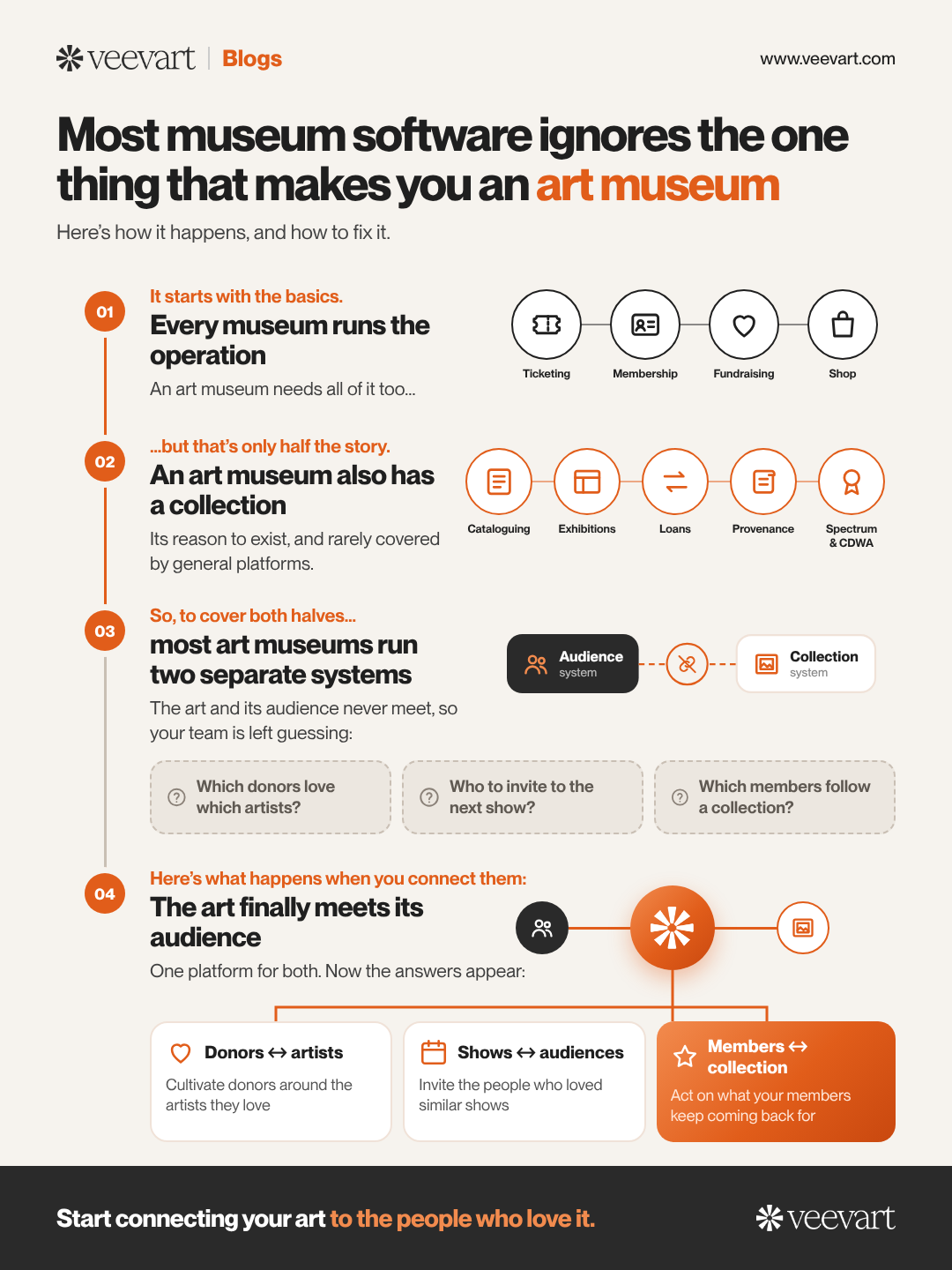
But an art museum has a need the others mostly don't. It has a collection. From cataloguing objects and developing exhibitions to managing loans, documenting provenance, and upholding professional standards. ****A platform built for the general museum market often treats this as an afterthought, or ignores it entirely.
That gap is the subject of this piece. This article goes into what an art museum shares with every other museum, what sets it apart, and what to look for in software that actually fits.
What's the Same
Start with the overlap, because it's large. An art museum is still a museum. It has the same operational and relationship needs as any other institution in the sector.
It sells admission, often with timed entry for special exhibitions
It runs a membership program with tiers, benefits, and renewals
It raises money from donors, grants, and campaigns
It operates a shop and sometimes a cafe or venue rentals
It runs lectures, tours, and education programs
It needs to understand its visitors and build lasting relationships with them
None of this is different for an art museum. All of it matters just as much. A platform that handles these well is doing the core work any museum requires. (For the full picture of those needs, see The Complete Guide to CRM for Museums and Cultural Institutions)
So the operational half of an art museum's software needs is shared ground. The difference is the other half.
What's Different: The Collection
An art museum is a collecting institution. Its collection is the reason it exists. And managing that collection is a discipline with its own requirements that general museum platforms rarely address.
Cataloguing objects. Every work needs a detailed record. Artist, medium, dimensions, date, condition, acquisition details, location, and more. This is a structured, standards-driven kind of record-keeping, very different from a visitor or donor record.
Exhibition management. Mounting a show involves selecting works, planning the space, tracking what goes where, and coordinating the logistics. This is project work tied directly to the collection, and it has no equivalent at a science center or zoo.
Loans. Art museums lend works to other institutions and borrow for exhibitions. Each loan has agreements, conditions, insurance, and tracking requirements. Managing incoming and outgoing loans is a core collections function.
Provenance and documentation. The history of a work, its ownership, and its condition over time all have to be recorded and maintained. For art, provenance is not a nice-to-have. It is central to the object's integrity and value.
Professional standards. Collections work follows established frameworks. Spectrum, the collections management standard maintained by the Collections Trust, defines the procedures for documenting and managing objects. CDWA, the Getty's Categories for the Description of Works of Art, provides the standard for describing art objects themselves. A serious collections tool reflects these standards. A general museum platform usually has never heard of them.
This is the half of an art museum's needs that the general market leaves out. And it is not a minor half. It is the institution's core purpose.

The Two-Systems Reality
Here is how most art museums end up solving this. They run two separate worlds.
One system handles the operation: ticketing, membership, fundraising, the visitor and donor relationships. This is the general museum platform, and it does that job.
A second, separate system handles the collection: cataloguing, exhibitions, loans, following the art standards. This is a dedicated collections management system, and some of these tools are genuinely deep and sophisticated.
For many art museums, this split is reasonable. A dedicated collections system can offer depth that a broader platform may not match, and the collections team and the development team often work fairly independently day to day. If the collection work is highly specialized, keeping a deep standalone tool for it can be the right call.
But the split has a cost, and it is the same cost that fragmentation creates everywhere: the two worlds can't see each other.
Where Connecting the Two Worlds Matters
The operational data and the collection data are usually treated as unrelated. Sometimes they are. But often there is real value in connecting them, and that value is invisible when the systems are separate.
Consider a few examples. A major donor has a known interest in a particular artist or period. When the collection data and the donor data connect, the development team can see which supporters care about which parts of the collection, and cultivate accordingly. A new exhibition is going up. When exhibition data connects to ticketing and membership, the institution can see exactly who engaged with past shows like it and market to them precisely. A member attends every event tied to the modern collection. That signal, joining collection engagement to membership behavior, tells the institution something it could act on.
None of these connections are possible when the collection lives in one system and the audience lives in another. The works and the people who love them are managed in separate worlds that never meet.
This is the honest case for an integrated platform. It’s not about replacing a dedicated collections system in every case. For many art museums, bringing collections and constituent data together reveals connections between the art and its audience that separate systems often miss. (On the general value of connected data, see How Museums Can Turn Everyday Visitor Data into Strategic Insight)
What Art Museums Should Look For
If you run an art museum evaluating software, the general buyer's advice applies, plus a few collection-specific questions.
Does it handle the operation well? Ticketing, membership, fundraising, and programs still have to be strong. The collection is not the only thing.
Does it offer real collections management, or ignore it? Many museum platforms stop at the operational layer. Ask directly whether cataloguing, exhibitions, and loans are supported.
Does it reflect professional standards? Ask about Spectrum procedures and art description standards like CDWA. A tool built with these in mind understands collections work. One that can't name them probably wasn't built for it.
Can collection data and audience data connect? This is the question most worth asking, because it is the one a two-system setup can never answer yes to. If connecting the art to the audience matters to you, a platform that holds both is worth serious consideration.
How deep does the collections capability need to be for you? Be honest about your own requirements. A museum with highly specialized collection needs may want a dedicated system. One that values the connection between collection and audience may be better served by an integrated platform.
The Takeaway
Art museums are often sold the same software as every other museum, and that software frequently handles everything except the thing that makes an art museum what it is. The collection.
The right tool for an art museum covers both halves of its reality. The operation it shares with every museum, and the collection that sets it apart. Whether that means a deep standalone collections system alongside a general platform, or a single platform that holds both, depends on how specialized the collection work is and how much value the institution sees in connecting its art to its audience.
What an art museum should not do is accept software that treats the collection as an afterthought. For an art museum, the collection was never the afterthought. That was the whole point.
Veevart is a museum-native platform that unifies ticketing, membership, fundraising, and programs with collections management, so an art museum can run its operation and manage its collection in one connected system, with the art and the audience finally in the same place. See how it works