How Museums Build Board-Ready Financial Reports (Without Manual Spreadsheet Work)
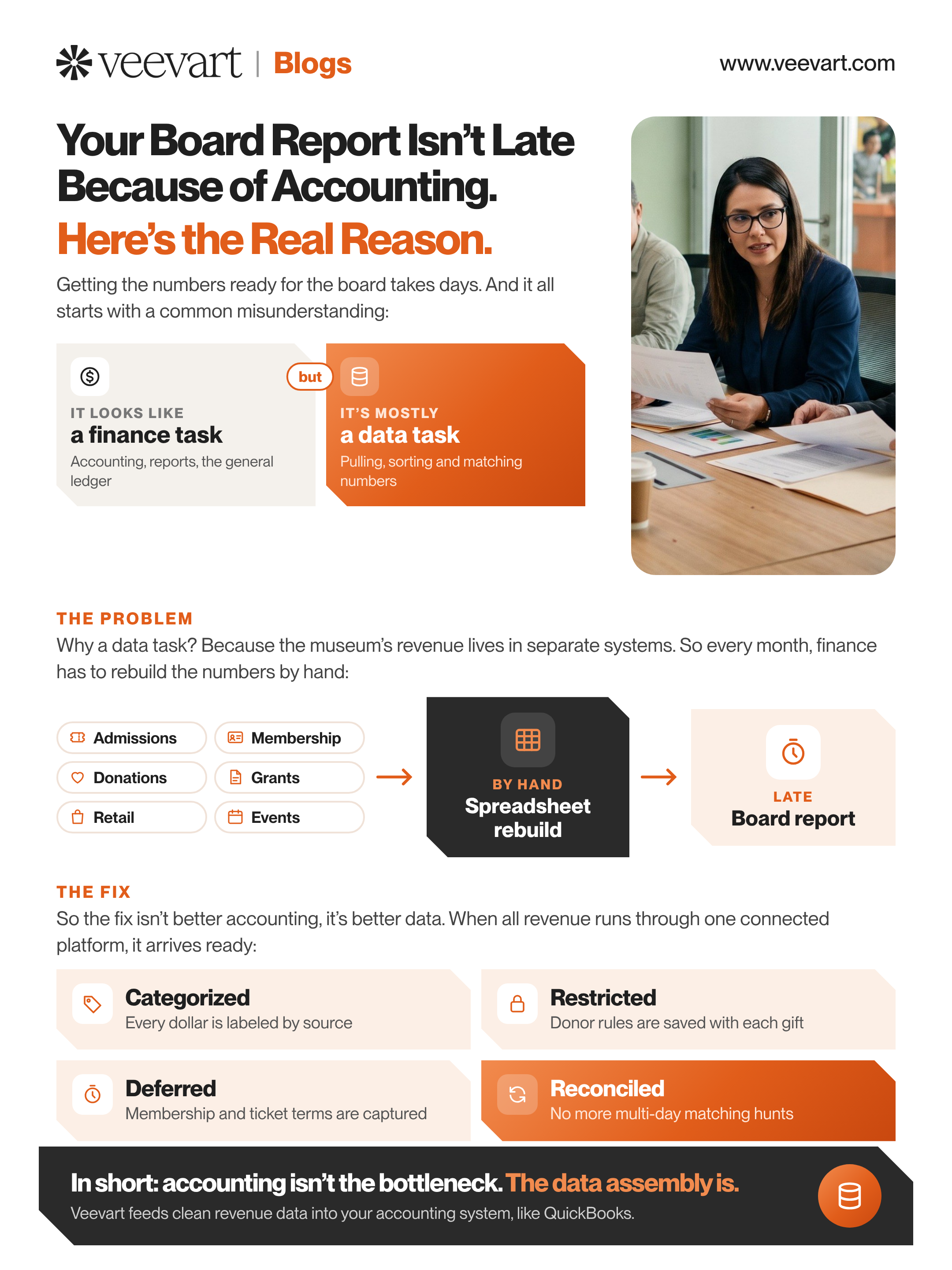
The board meets next week. Someone is building the financial report by hand.
They are pulling admissions revenue from the ticketing system. Membership dues from another. Donations and grants from the donor database. Shop sales from the POS. Then they are dropping it all into a spreadsheet, categorizing it, reconciling it against the accounting system, and shaping it into something the board can read.
It takes days. And here is the part worth noticing. Most of that time is not spent on accounting. It is spent on assembly. Gathering scattered revenue data and forcing it into one coherent picture. The actual financial work is the small part. The manual data wrangling is the rest.
That is the hidden problem behind board-ready reporting at most museums. It looks like a finance task. It is mostly a data task. And the data task exists only because the revenue lives in systems that do not talk to each other.
Why Museum Financial Reporting Is Harder Than It Looks
A museum's finances are more complex than a single revenue line. The board report has to reflect that complexity accurately, and several things make it genuinely hard.
Revenue comes from many sources. A statement of activities breaks revenue down by source. For a museum that means admissions, membership, donations, grants, retail, events, and more. Each source typically lives in its own system. Reporting revenue by source means pulling from all of them and making them agree.
Restricted and unrestricted funds must be separated. Nonprofit reporting distinguishes funds the donor restricted from funds the institution can use freely. That distinction has to be captured when the gift is recorded, not reconstructed at month-end. If the donation system does not tag restrictions at the source, someone sorts it out by hand later.
Memberships and advance sales create deferred revenue. When a member pays for a full year up front, that money is not all earned the day it arrives. The same goes for tickets sold for a future date. Under accrual accounting, this is deferred revenue, recognized over time. Tracking it correctly requires knowing the terms behind every transaction, which the raw dollar figure alone does not provide.
Grants carry compliance requirements. Grant funds often come with restrictions on use and obligations to report. Tracking grant spending against those terms is part of the financial picture, and it has its own paperwork.
None of this is optional. It is what accurate nonprofit reporting requires. The question is whether the institution produces it cleanly or assembles it by hand every month.

Where the Manual Spreadsheet Work Actually Comes From
Here is the key insight for anyone trying to make board reporting less painful. The manual work is not in accounting. It is in the data assembly that happens before the accounting.
Think about what the finance person is actually doing in that pre-board scramble. They are not struggling with GAAP. They know accounting. They are struggling to get clean, categorized, reconciled revenue data out of systems that were never designed to hand it over.
The admissions system reports a number. The membership system reports another. Neither is categorized the way the statement of activities needs. Neither flags what is restricted. Neither accounts for the deferred portion. So the finance person rebuilds all of that in a spreadsheet, every month, by hand.
The month-end close drags because of this. The report is late because of this. And the numbers come with quiet caveats because a process this manual always carries the risk of a missed entry or a mismatched figure. (This is the same fragmentation problem seen from the finance seat. For the operational view, see The Hidden Complexity of Museum Financial Reconciliation)
Accounting is not the bottleneck. The data assembly is.
What Changes When the Revenue Data Is Clean
Fixing board reporting does not mean replacing your accounting system. It means fixing the data that feeds it.
When the operational revenue sources run through one connected platform, the data arrives at the accounting layer already in good shape. A few things change immediately.
Revenue is categorized at the source. Admissions, membership, donations, grants, and retail are already tagged by type as they are recorded. Revenue by source is a report, not a reconstruction.
Restriction is captured when the gift is recorded. A restricted donation is marked restricted the moment it comes in. The restricted versus unrestricted split is maintained from the start, not sorted out later.
Deferred revenue is grounded in real terms. Because the system knows the membership period and the ticket date behind each transaction, the data needed to recognize revenue correctly over time is there, rather than estimated by hand.
Reconciliation mostly disappears. When the revenue data is already consistent and connected, matching it against the accounting system stops being a multi-day hunt for discrepancies.
The result is that the finance team spends month-end doing finance, not data entry. The board report becomes a product of the system rather than a manual construction, and it reflects reality as of now rather than three weeks ago.

Being Clear About the Division of Labor
One honest point, because finance readers will rightly ask it. A platform like this does not replace your accounting software, and it does not produce your audited financial statements.
Your accounting system still does the accounting. It holds the general ledger. It produces the statement of activities and the statement of financial position. It is where GAAP compliance lives.
What a unified operational platform does is upstream of that. It makes the revenue data clean, categorized, and reconciled before it reaches the accounting system. It handles the assembly work that currently eats the finance team's time. Think of it as fixing the inputs, so the accounting system can do its job without a human manually preparing its data first. The two work together. One runs the operation and feeds clean revenue data. The other does the accounting. (For how the operational side connects, see The Complete Guide to CRM for Museums and Cultural Institutions)
This distinction matters, because the goal is not a magic button that produces board reports. It is the removal of the manual data work that makes those reports so painful to produce today.
The Takeaway
Board-ready financial reporting feels like an accounting burden. For most museums, it is really a data burden wearing accounting clothes.
The days lost before each board meeting are days spent assembling scattered revenue into one picture. Fix the scatter, and most of that work goes away. The accounting was never the slow part. The manual preparation was.
The institutions that produce clean board reports without the monthly scramble are not the ones with better accountants. They are the ones whose revenue data was already connected, categorized, and reconciled before the finance team ever opened the file. That is a solvable problem. And solving it gives the finance team back the one thing the board scramble always takes: time.
Veevart unifies admissions, membership, donations, and retail revenue in one platform and integrates with accounting tools like QuickBooks, so the revenue data behind your board reports arrives clean, categorized, and reconciled, not assembled by hand. See how it works